NGUINEA-013 - museum specimen
Roro rhombes, Yule district (Quai Branly 1933 lot)
Papua New Guinea - Central Province - Bereina subdistrict - Roro Islands - Oceania - Sahul
Restricted
beriwa English
Source term: Rhombe
beriwa: the Roro word for the bull-roarer, which is also the name of the spirits of the dead (and of malevolent beings that were never human) — beings of damp, fertile ground near springs, 'where some exist as snakes'; the neighbouring Nara, who swing the bull-roarer for crop growth, likewise call it beriwa. C. G. Seligmann, The Melanesians of British New Guinea (1910), p. 304.
Etymology. Among the Roro-speaking tribes the bull-roarer is called beriwa — the same word used for the spirits of the dead, and for malevolent beings that were never human. Seligmann adds that the neighbouring Nara, who swing the bull-roarer to make their crops grow, likewise call it beriwa. (high confidence)
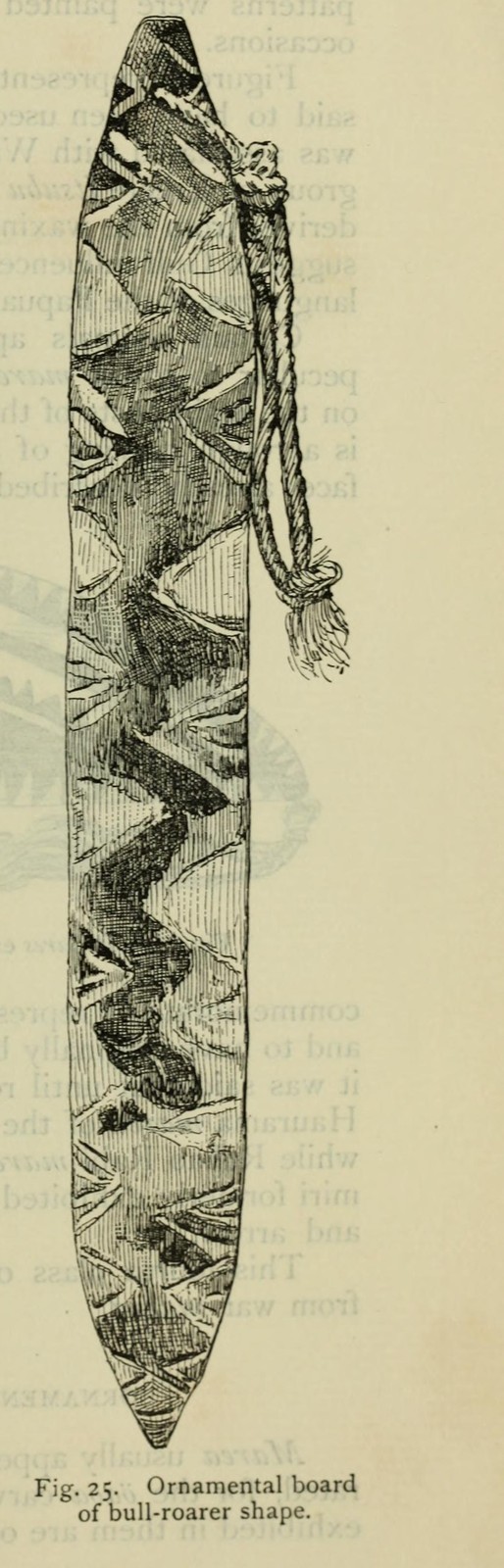
A bullroarer — a rhombe — from the Roro-speaking coast of Hall Sound, the shore and low islands around Yule Island and Bereina in the Central Province of Papua New Guinea, held by the Musée du quai Branly – Jacques Chirac (object 9647, acquired in 1933). The register records nothing of how it was swung, but C. G. Seligman's The Melanesians of British New Guinea (1910) does: among the Roro-speaking tribes, at Waima and Hisiu on this same coast, the kaivakuku — masked taboo-experts who alone could pronounce the most dreaded form of taboo on vegetable food — walked the village by day on the sides of their feet so as not to be recognized, and "at night they would swing bull-roarers." In Roro the instrument's name, beriwa, is also the word for spirits, beings of damp fertile ground near springs — some of whom, Seligman writes, "exist as snakes."
Beriwa, (1) spirits, not necessarily of the dead, non-human agencies (Roro); (2) bull-roarers (Pokao)
Seligman, The Melanesians of British New Guinea (1910), Glossary p. 748
- Object
- Two rhombes from the Roro country around Hall Sound, Quai Branly objects 9647 and 9649 (inventory 71.1933.88.49.1-2 and 71.1933.88.50.1-2), consecutive numbers in the same 1933 accession lot.
- Function
- Function not recorded.
- Map confidence
- medium - Representative Roro Islands / Bereina-Yule area anchor.
- Source location
Page references
Quai Branly object 9647 / inventory 71.1933.88.49.1-2 | Quai Branly 9647 + 9649; inventory 71.1933.88.49-50
- Snake-linked