No. NAMER-005
Bone roarer among bear canines
United States · Tennessee · Hawkins County · site 40HW44 · North America · Eastern Woodlands
Function not recorded
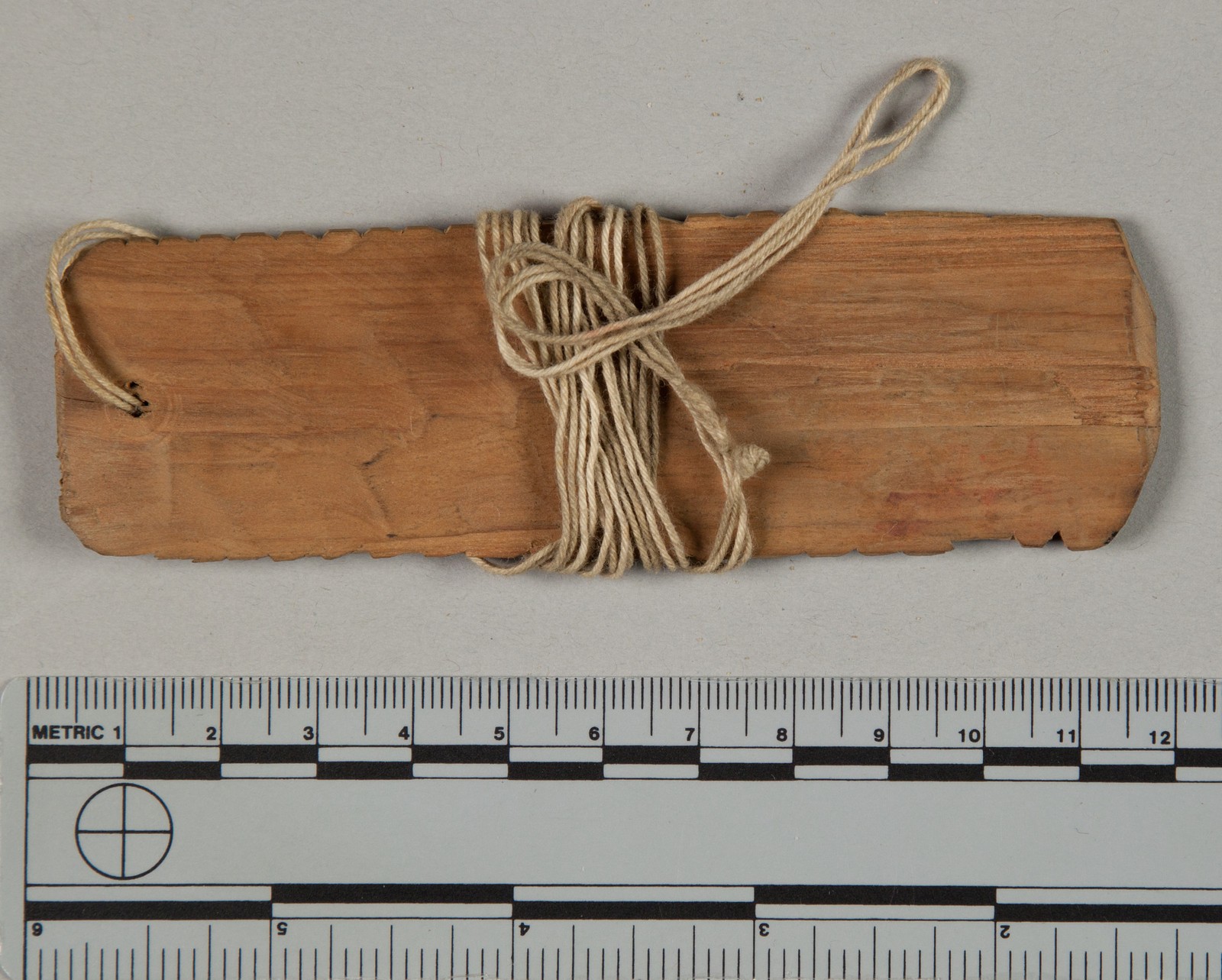
Source term: bone bullroarer
A bone bullroarer was buried with the dead at site 40HW44 in Hawkins County, Tennessee, in the Holston River drainage. From June 23 to August 19, 1976, the University of Alabama's Office of Archaeological Research removed the remains of at least 13 individuals, most of them adult men, from the site; five radiocarbon dates place its primary occupation in the Early Woodland period, 1000 to 300 B.C. The bullroarer was one of 132 associated funerary objects, lying among 69 drilled bear canines, beaver incisors, an antler handle, a bone pin, chert debitage, and an animal-tooth pendant. The Tennessee Valley Authority later determined that no shared group identity could be reasonably traced between these dead and any present-day Indian Tribe. How it sounded, and who once swung it, are not recorded.
…placed with or near individual human remains at the time of death or later as part of the death rite or ceremony.
Federal Register 2019-00836, Notice of Inventory Completion: Tennessee Valley Authority, Knoxville, TN (Feb. 4, 2019)
Particulars
- Object
- Bone bullroarer, buried as a funerary object.
- Function
- Not recorded.
Source
Federal Register notice 2019-00836, Tennessee Valley Authority, Knoxville, TN