No. NAAIN-001
Yen' wihəre, wind turns
United States · South Carolina Piedmont · North America · Eastern Woodlands
Play / practical
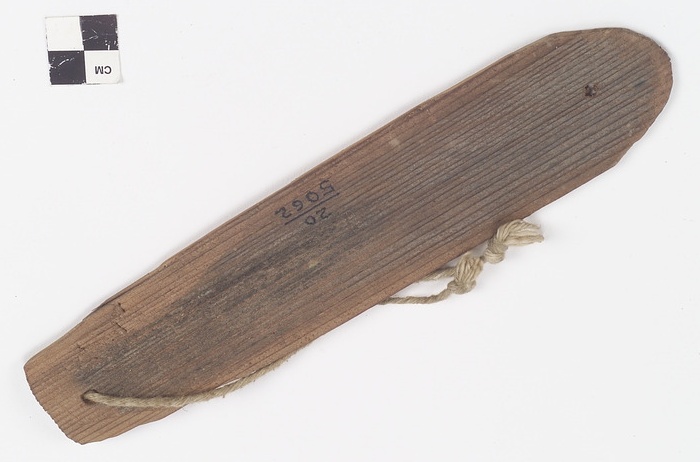
yen' wihəre
Source term: Bullroarer
A bullroarer of carved wood from the Catawba of the South Carolina Piedmont, collected by the salvage ethnographer Frank G. Speck and sold by him to the Museum of the American Indian in New York in 1942. It comes from Rock Hill, in York County, where the Catawba reservation lay a few miles south of town. A companion piece in the same Catawba lot is a thin sheet of pine bark cut with incised lines rather than carved wood, a hint at how plain the form could be. Speck's own 1944 survey of Catawba games gives the name and the sound: the Catawba called it yen' wihəre, "wind turns," cut from a notched blade of gourd rind, yellow pine bark, or cypress shingle six to seven and a half inches long, strung on about two and a half feet of cord, and whirled to a deep tremolo humming. He went looking for a rite behind it and found none.
Particulars
- Object
- Thin carved wooden blade, rounded at one end, on its cord.
- Function
- A children's toy: Speck listed the whizz-board, yen' wihəre, "wind turns", among Catawba games and amusements and said plainly that no purpose or symbolism could be found attached to it.
Source
Smithsonian National Museum of the American Indian, 20/5062 (Catawba, Rock Hill, South Carolina; collected by Frank G. Speck); Frank G. Speck, 'Catawba Games and Amusements,' Primitive Man 17(1-2) (1944): 19-28