No. NAAIN-005
Mattaponi, the eastern seaboard exception
United States · Virginia · King William County · North America · Eastern Woodlands
Function not recorded
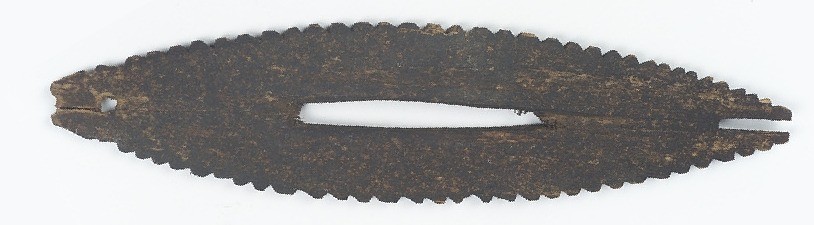
Source term: Bullroarer
One of the few bullroarers ever recorded for the Eastern Woodlands, collected on the Mattaponi Reservation in King William County, Virginia. Mattaponi carvers made it in an "old" and a "new" type, as Frank G. Speck found when he collected among them about 1920; what they swung it for is lost. Its weight is geographic. Theodore Seder, mapping the bullroarer in 1952 across Australia, Melanesia, South America, Africa and most of North America, named the rare blanks, among them the eastern seaboard — with a single exception: the Mattaponi, the people from whom this stick came.
This simple instrument was used almost everywhere in the world, although there are occasional places where it is not found, such as Finland, northeastern Asia (except the Chukchee), and the eastern part of North America (excluding the Mattaponi).
Seder 1952, "Old World Overtones in the New World," University Museum Bulletin 16(3-4), Univ. of Pennsylvania
Particulars
- Object
- Carved wood bullroarer collected in 1920 by Frank G. Speck
- Function
- Not recorded.
Sources
- Frank G. Speck, Chapters on the Ethnology of the Powhatan Tribes of Virginia, Indian Notes and Monographs 1(5), Museum of the American Indian, Heye Foundation (1928), p. 448, fig. 134 View
- Smithsonian National Museum of the American Indian, 9/7738, object NMAI_105655, barcode 097738
- Seder, “Old World Overtones in the New World,” University Museum Bulletin 16(3–4) (1952)