No. MUS2026-194
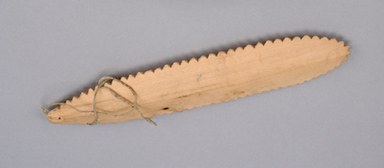
Pelly Bay Netsilingmiut bullroarer (CMH IV-C-3299)
Canada · Kitikmeot · Pelly Bay (Kugaaruk) · North America · Arctic
Play / practical
imiklutAQ
Source term: imiklutAQ (Rasmussen's Netsilik orthography)
imiklutAQ — Rasmussen's Netsilik term covering both the whirled bull-roarer and the two-cord buzz.
When the ethnographer Asen Balikci began his years at Pelly Bay — fieldwork that became the famous Netsilik film series — one of the things he carried out was this: a hand's-span blade of wood, saw-toothed along both edges, on a cord of mammal sinew. Rasmussen had already written its name into the record a generation earlier: imiklutAQ, listed among the games, a piece of wood cut to shape and whirled round for its humming noise — the sound of children playing on the sea ice of one of the coldest inhabited places on earth.
Particulars
- Object
- Serrated wooden bullroarer, 24.0 x 5.1 x 1.5 cm, a mammal-sinew cord through its terminal hole; collected March 1960 or earlier.
- Function
- A child's game.
Source
Canadian Museum of History IV-C-3299: bullroarer, Netsilingmiut, Pelly Bay/Kugaaruk, wood and mammal sinew, 24.0 x 5.1 x 1.5 cm, collected by Asen Balikci, March 1960 or earlier; Knud Rasmussen, The Netsilik Eskimos (Report of the Fifth Thule Expedition VIII, 1931), games list, p. 357