No. MUS2026-047
Five Cypriot village noisemakers
Cyprus · Near East
Play / practical
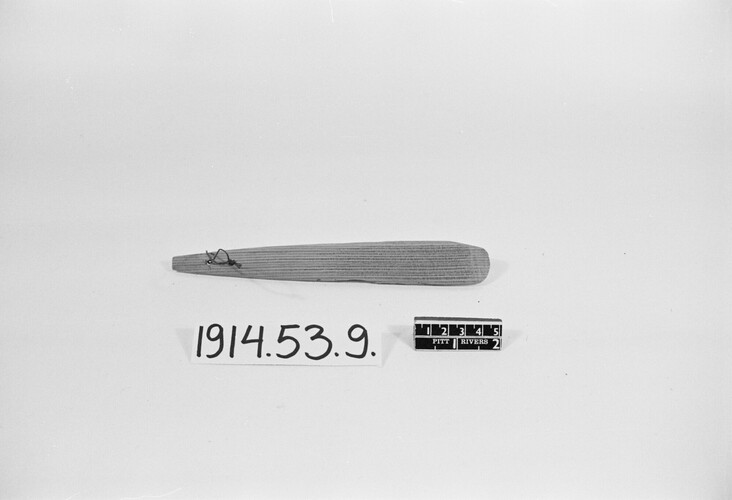
foveristra; zizirista; vounistra
Source term: bull-roarer
foveristra (φοβερίστρα, "frightener", from φοβερίζω to frighten), zizirista (ζιζιρίστρα, cicada-buzzer) and vounistra: the three names Cypriot boys gave the wooden bullroarer in 1913.
One of five wooden bull-roarers collected in Cyprus by the anthropologist Leonard Halford Dudley Buxton, who came to the island in 1913 to excavate the Bronze Age tombs of Lapithos under John Myres and the Cyprus Museum's curator, Menelaos Markides. Alongside the digging he gathered everyday objects from the villages — hand-loom gear like spindles and loom-treadles, a friction-drum, a sheep-bell, wooden toys — and these five noisemakers from Akanthou, Lapithos, Enkomi, and Karavas, which he presented to the Pitt Rivers Museum in Oxford in 1914. Buxton's own report of the trip says what they were: trying without much success to collect children's toys, he found the boys' little bullroarers going by three names — the frightener, the cicada, and vounistra. These five are those boys' toys.
Most of the boys used little wooden bullroarers which they called foveristra, zizirista, or vounistra.
L. H. Dudley Buxton, "The Anthropology of Cyprus", Journal of the Royal Anthropological Institute 50 (1920), p. 191
Particulars
- Object
- Wooden bull-roarer, a tapering slat with a scrap of cord still knotted at its narrow end; Pitt Rivers Museum, Oxford (acc. 1914.53.9).
- Function
- A boys' toy.