MUS2026-007 - museum specimen
Kamia (Kumeyaay) bull-roarer (museum specimen)
United States - Imperial Valley, California - North America
Function not recorded
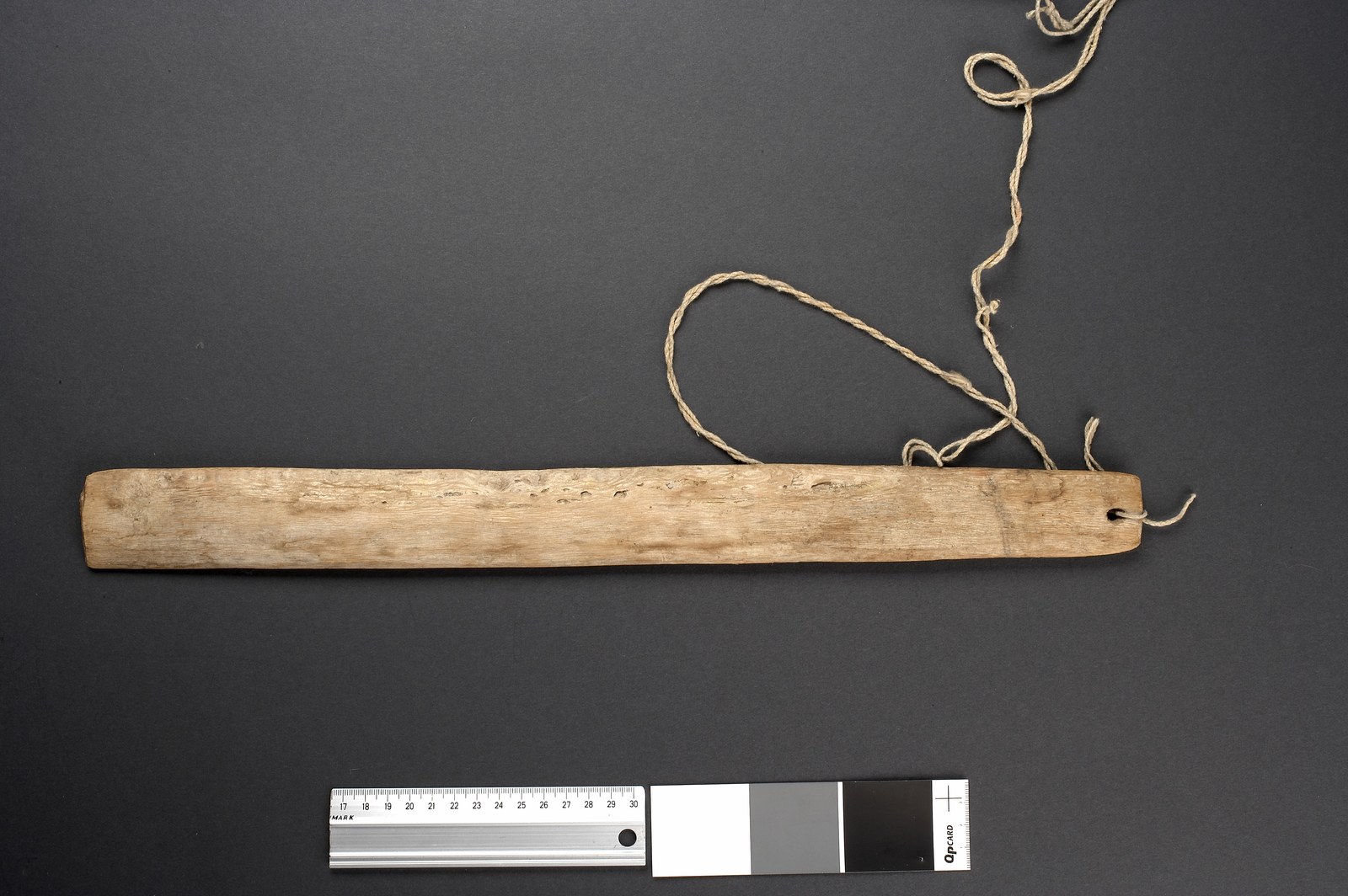
Source term: bull-roarer
The Smithsonian's National Museum of the American Indian holds a bull-roarer of the Kamia, the desert division of the Kumeyaay who raised maize, beans, and teparies on the floodplains of California's Imperial Valley, and the museum withholds its image as a culturally sensitive object rather than displaying it as a toy. That handling is the firmest fact on record. Among the Kumeyaay the ceremonial sound-makers were gourd and turtle-shell rattles and reed flutes, and the boys' initiation centered on the toloache rite, in which they drank a datura infusion, fasted, and danced until the drug brought on a vision meant to guide them for life. A Kamia man of the KwoL clan, questioned in the mid-1930s, remembered the bullroarer among his people as a toy rather than a ceremonial call. What part this specimen itself played is not documented; the museum treats it as restricted.
Rattles, cane flutes, and cane whistles were the Kamia musical instruments. Drums, bull roarers, and musical bows were absent.
E. W. Gifford, The Kamia of Imperial Valley (BAE Bulletin 97, 1931), p. 43
- Object
- Bull-roarer of the Kamia (Kumeyaay), in the collection of the Smithsonian's National Museum of the American Indian (NMAI).
- Function
- Museum-withheld as culturally sensitive; no use recorded for this specimen. Mid-1930s Kamia (KwoL) testimony reported the bullroarer as a toy.
- Map confidence
- medium - approximate culture/locality centroid
- Source location
Page references
National Museum of the American Indian (NMAI)