No. HEIZER1964-001
Tuluwat engraved bone blades
United States · Humboldt Bay, California · Wiyot country · North America
Function not recorded Candidate only
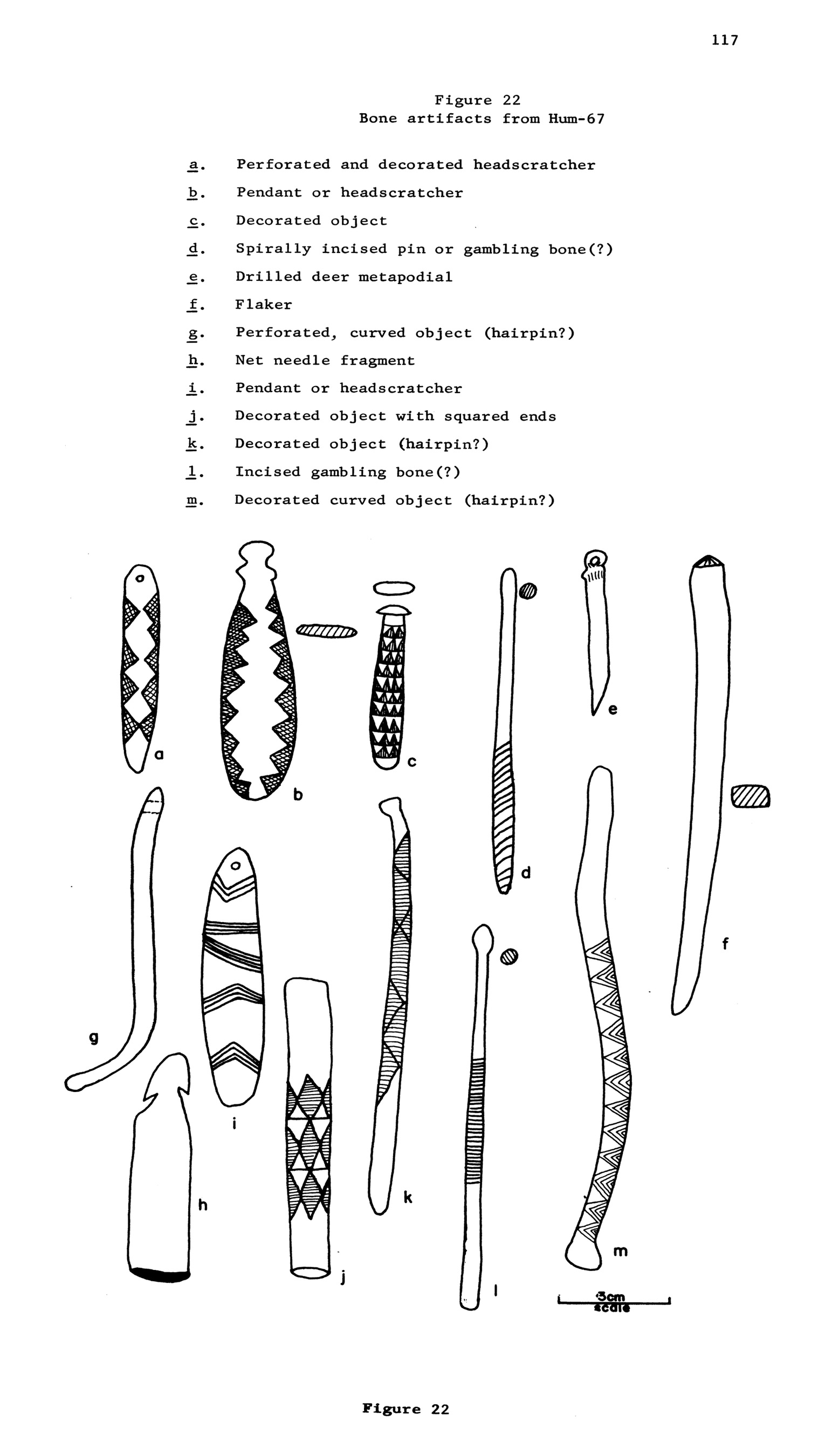
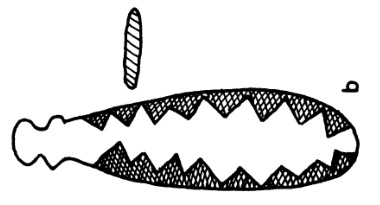

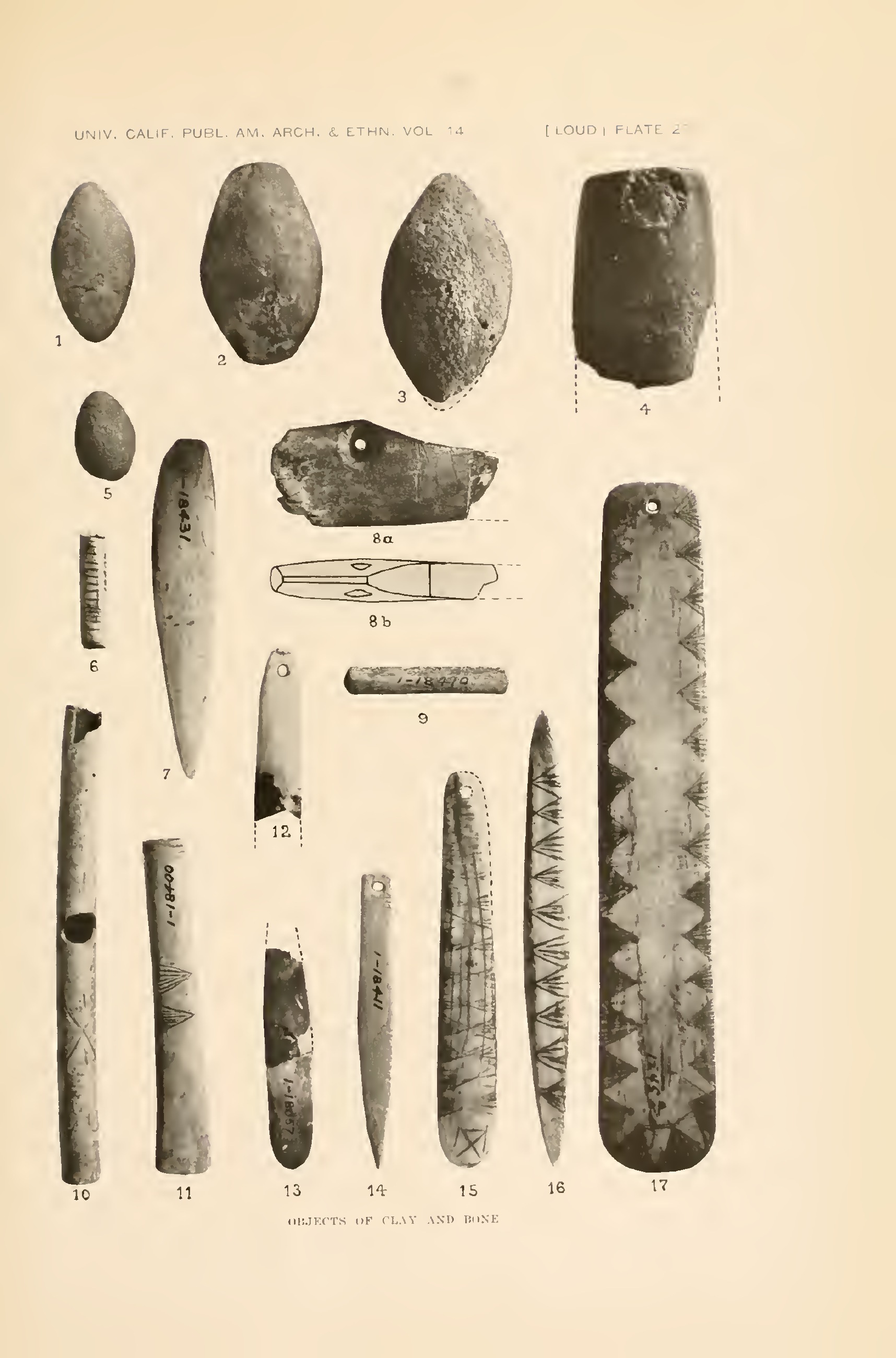

Source term: headscratcher; pendant or headscratcher
Three thin bone blades from the great shellmound at Tuluwat are engraved edge to edge with cross-hatched triangles and chevrons. Two are pierced near one narrow end; the third ends in a rounded knob above an undercut neck, a ready seat for a cord. The excavation report calls them headscratchers, with a confidence that is itself a head-scratcher. A bone bullroarer catalogued as Karuk, from the same county, has the same pierced end and opposed triangles, its cord still attached. Just to the south, Sinkyone and Kato men whirled wooden bullroarers; to the Kato the roar was the voice of thunder, and it brought the storm. Tuluwat is the centre of the Wiyot world and the place of their creation, where each spring hundreds gathered for the World Renewal dances. In 1860, during a break in the ceremony, settlers came in the night and killed nearly a hundred sleeping women, children and elders. The Wiyot danced the World Renewal there again in 2014; in 2019 Eureka returned its remaining share of the island.
Particulars
- Object
- Three flat, geometrically engraved bone blades: two pierced near one narrow end, the third finished with a rounded knob above an undercut neck.
- Function
- Not recorded.
Sources
- Robert F. Heizer and A. B. Elsasser, Archaeology of Hum-67 (1964), pp. 7–9, 32 and fig. 22a, b, i View · archived
- Wiyot Tribe, A Photographic Exploration of Wigi: Tuluwat and Wigi place names View · archived
- L. L. Loud, Ethnogeography and Archaeology of the Wiyot Territory (1918), p383 and plate20 View · archived
- US Fish and Wildlife Service, Humboldt Bay NWR Complex Comprehensive Conservation Plan (September2009), p61: Tuluwat occupation View
- Wiyot Tribe, Tuluwat Project: World Renewal Ceremony and shellmound View
- Wiyot Tribe, Landback: Tuluwat creation place, massacre and ceremonial return View
- US Environmental Protection Agency, Returning Sacred Land: The Indian Island Superfund Site and the Wiyot Tribe, California (March2018), p19 View
- Smithsonian National Museum of the American Indian, 18/9685: Karuk bone bullroarer, Humboldt County View
- M. A. Baumhoff, Excavation of Teh-1 (Kingsley Cave), UCAS Reports 30 (1955), p. 53 and plate 1f View
- H. E. Driver, Culture Element Distributions: X, Northwest California, Anthropological Records 1(6) (1939), p. 337, elements 1341–1345 View · archived