No. HAD1898-021
Toba-Batak Sumatra toy bullroarer
Indonesia · Southeast Asia
Play / practical
Source term: bull-roarer
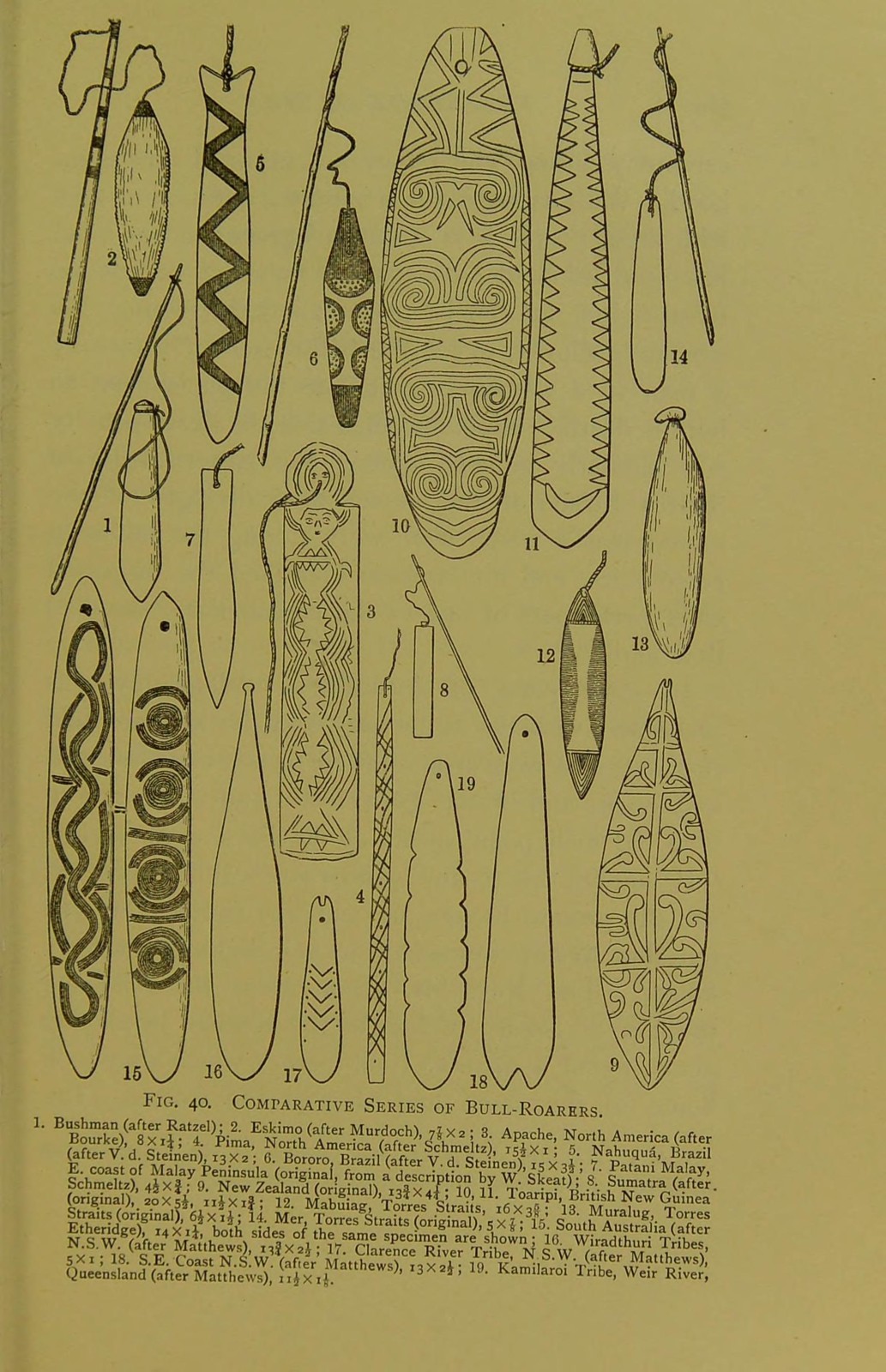
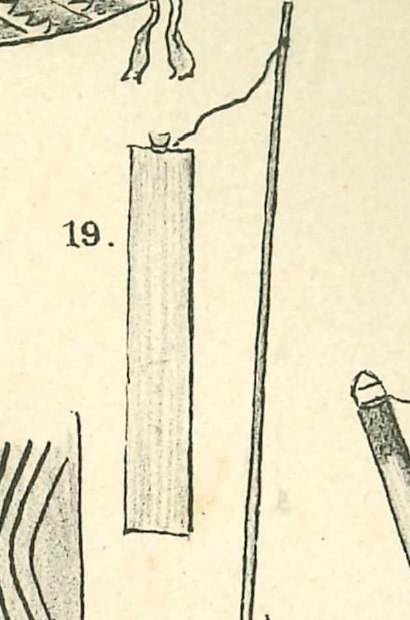
A plano-convex strip of wood, narrow and oblong, about four and a quarter inches long: among the Toba-Batak of Sumatra this was a plaything for small children. Schmeltz, director of the ethnographical museum at Leiden, counted it as the only true bull-roarer he knew from the whole Malay Archipelago, and Haddon reproduced it in his comparative plate of bull-roarer forms. A second piece at Leiden, a child's toy from Java, resembled a bull-roarer closely enough to note but was set aside as possibly of separate origin. No ritual use is recorded for the Batak object; in the source it is only a children's toy.
Schmeltz knows of only one true example of the bull-roarer from the Malay Archipelago. It occurs among Toba-Batak of Sumatra and is a plano-convex, narrow, oblong piece of wood about 4¼ inches in length. It is only a plaything for small children.
Haddon 1898, The Study of Man, p. 299 (citing Schmeltz, "Das Schwirrholz," 1896, p. 103)
Particulars
- Object
- Plano-convex, narrow, oblong piece of wood about 4¼ inches long; figured by Haddon as Fig. 40 No. 8. Schmeltz p. 102 describes the Leiden object 464/86 (coll. Bernhard Hagen): an 11.5 x 2 cm plano-convex blade with a peg terminal, cord and bamboo handstick — a children's toy.
- Function
- Plano-convex narrow oblong bullroarer reported as a small children's plaything.
Source
J. D. E. Schmeltz, 'Das Schwirrholz: Versuch einer Monographie,' Verhandlungen des Vereins für naturwissenschaftliche Unterhaltung zu Hamburg 9 (1896): 92-128, at p. 102, fig. 19; A. C. Haddon, The Study of Man (1898), p. 299, fig. 40 no. 8