EVANS1975-001 - archaeological find
Glenviggan thunder-spade
United Kingdom - Glenviggan townland, Six Towns, Co. Londonderry, Northern Ireland - Europe
Function not recorded Candidate only
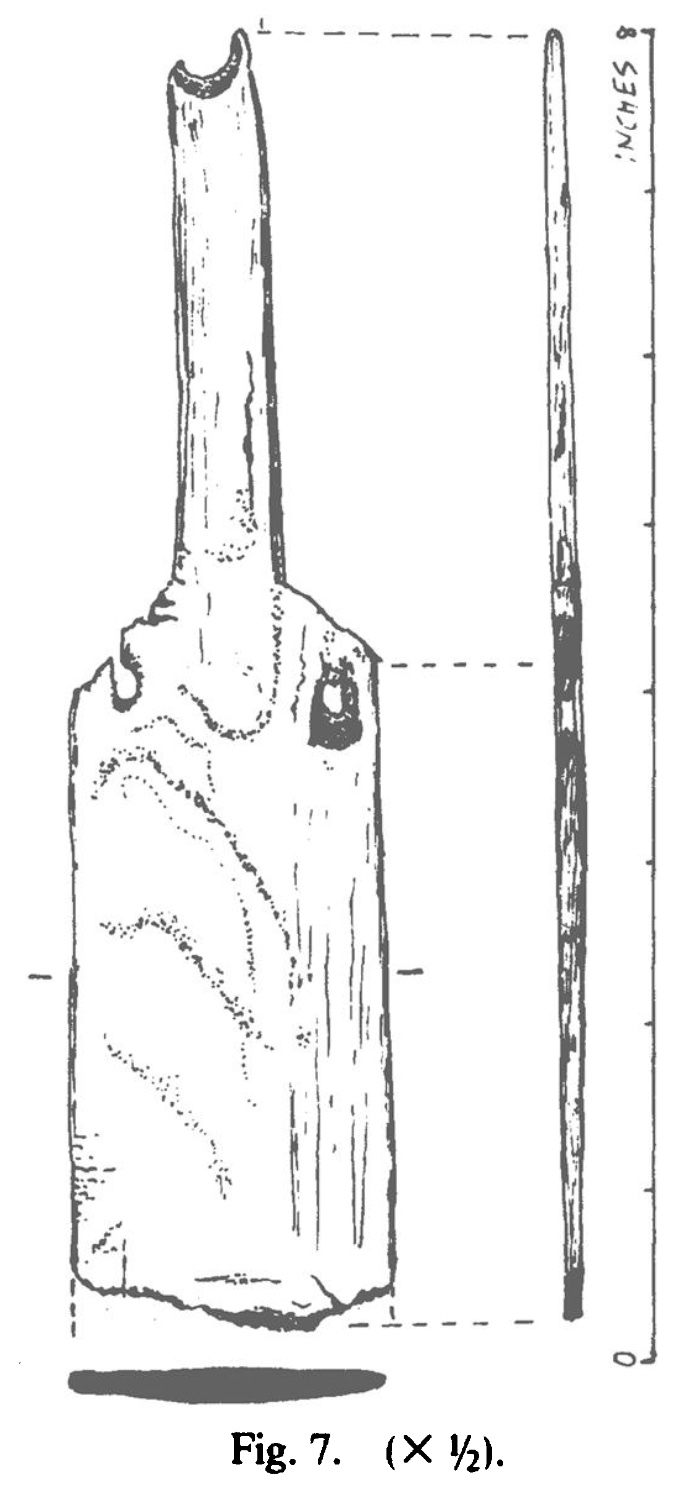
thunder-spade
Source term: bull-roarer (Gunn's exhibit label); possible bull-roarer (Evans)
thunder-spade: a local Co. Londonderry/Tyrone/Armagh-Down name for a children's toy bullroarer, per Evans a probable folk variant of the older British Isles names thunder-spell/thunder-spale (spale/spell/spall = a wood or stone chip); Irish cuirin buirthe, "little roaring board" (per Brendan Adams).
In spring 1963 a turf-cutter in James McBride's bank at Glenviggan, near Draperstown, brought up a long yew blade with an unusually long handle, forty inches down in the peat. A schoolmaster exhibited it as a bull-roarer 'resembling the Australian turndun and Greek rhombos'; an old man in the district knew it independently as a 'thunder-spade,' a children's toy from his own boyhood. Three fire-smoothed hourglass holes survive — one neat, at the tip, two crude and unexplained at the shoulders — leading one specialist to suspect instead a broken toy-sword hilt. The excavator held his ground: 'until a better explanation is forthcoming I prefer to regard the discovery as a bull-roarer.' Peat near the find spot, dated two years later, puts the surrounding bog at roughly 110 BC — a date on the ground, not the blade.
until a better explanation is forthcoming I prefer to regard the discovery as a bull-roarer
Evans 1975: 18
- Object
- A yew-wood blade with a long integral handle: 7.5 in. overall, of which the handle takes 3.25 in.; just under 2 in. wide and 0.2 in. thick. Three fire-smoothed hourglass perforations survive — one neatly made at the tip, two crude and mismatched at the shoulders, their purpose unexplained.
- Function
- Not recorded.
- Source
- E. Estyn Evans, "An Archaeological Miscellany," Ulster Journal of Archaeology 3rd ser. 38 (1975), pp. 12-18 (object pp. 16-18, Fig. 7), JSTOR 20567743; Ulster Archaeological Society
- Source location
Page references
Evans 1975, pp. 16-18, Fig. 7 (x 1/2); Welsh & Welsh 2022, p. 258, Fig. 299
- Source confidence
- high Published grid reference for the find spot, Irish Grid H 690 880 (easting 269000 / northing 388000 in Irish Grid, EPSG:29903 / TM65), transformed to WGS84.