No. SEAGERSMITH2000-001
Potterne split-rib blades
United Kingdom · Wiltshire, England · Europe
Function not recorded Candidate only
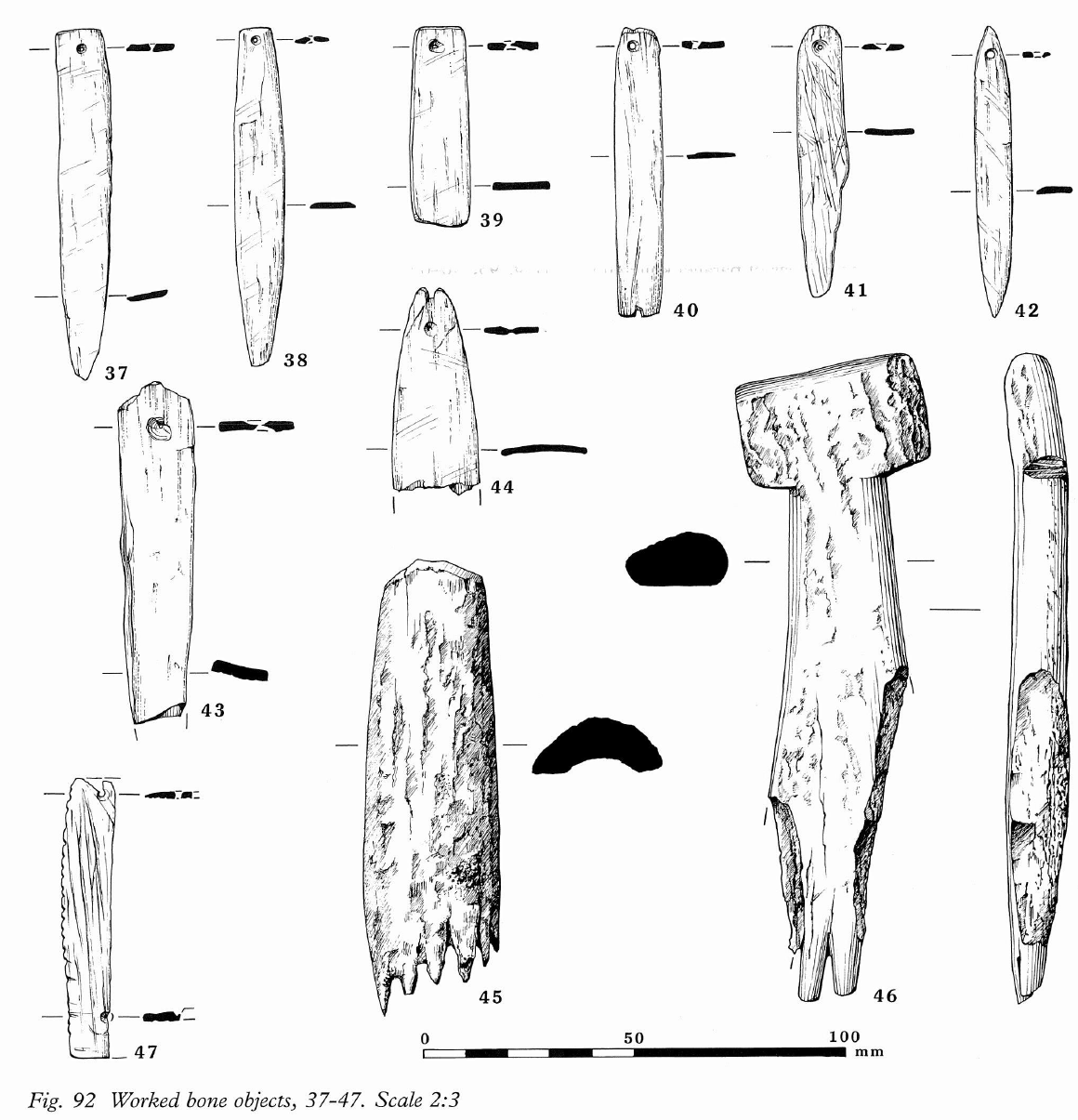
Source term: Thin blades with perforation (2.6)
Potterne’s bone-workers split the ribs of small hoofed animals and ground them into thin, flat blades, most of them long and leaf-shaped, boring a hole near one end before the final shaping. The two most complete are each about eight centimetres long and only a millimetre or two thick. Twenty-eight lay scattered through a site that also held spindle whorls and antler weaving combs, and Rachael Seager Smith filed them with its bladed tools. Some may well have parted or smoothed fibre. The slimmest, leaf-shaped and pierced at the broad end, have the shape of a bone bullroarer. Close matches turn up at All Cannings Cross, another great Wiltshire midden. Potterne came to light when a grave being dug in the village cemetery turned up a Late Bronze Age gold bracelet. Beneath lay a dark heap of trampled manure, butchered bone and broken pottery, three and a half hectares across and up to two metres deep; the small part excavated yielded a tonne of pottery and 135,000 animal bones. From about 1200 to 600 BC cattle were penned here, and crowds gathered to feast on animals raised all over southern Britain, among them pigs brought in from coast, wetland and inland country.
Particulars
- Object
- Twenty-eight thin, flat blades ground from split ribs of small hoofed animals, mostly long and leaf-shaped, usually pierced near one end.
- Function
- Not recorded.
Sources
- Seager Smith, worked bone, pp.228–229,233–235,237; Lawson, Powell and Thomas, Discussion, pp.262–264,270; in Lawson (ed.), Potterne 1982–5 (2000). View
- Lawson (ed.), Potterne 1982–5 (2000), summary p.ix and Introduction p.1. View
- Esposito et al., “Diverse feasting networks at the end of the Bronze Age in Britain (c. 900–500 BCE) evidenced by multi-isotope analysis,” iScience 28 (2025), 113271. View
- Ian Riddler, “Worked Bone,” §B.14.35, §B.14.50, in Oxford Archaeology, An Early Neolithic Funerary Monument and Late Bronze Age Settlement at land off Newmarket Road, Burwell, Cambridgeshire (v1, 2026), pp.451–452, 457–458. View