No. ERVYNCK1990-002
Dobbelslot diamond-marked rib
Belgium · East Flanders · Gent · Dobbelslot–Tempelhof · Europe
Function not recorded
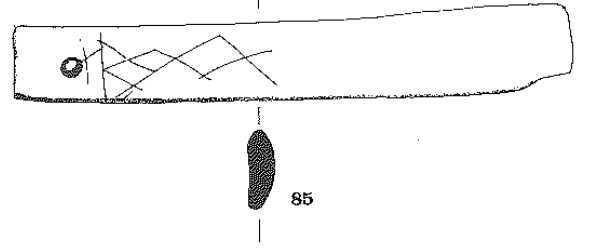
snorrebot
Snorrebot: Dutch “whirring bone,” a blade swung on a cord.
Someone scratched a loose lattice of diamonds across the pierced end of this rib, right beside its hole. Flattened into a strip about fourteen centimetres long, it is a snorrebot, one of the Low Countries’ whirring bones, and one narrow edge is worn from use. It comes from a seventeenth- or eighteenth-century deposit in Gent’s Dobbelslot quarter, one of the places in the city where bone-workers’ waste shows the craft was practised. Gent’s whirring bones span the better part of a thousand years. An older one, a strip of cattle or horse rib, lay in a ninth- to eleventh-century ditch in the Gouvernementstraat. Across the Low Countries children went on whirling these toys from the late Middle Ages onward, and Pieter Bruegel painted the flat-bone kind in his Children’s Games of 1560.
Particulars
- Object
- Flattened rib strip, about 14 cm long, with scratched diamond motifs, a hole near one end and a stout lens-shaped cross-section.
- Function
- Not recorded.
Sources
- Roland Van de Walle, Bewerkt been, gewei, hoorn en ivoor, Stadsarcheologie 6(2) (1982), pp.2–36; Fig.85 p.26 and pp.28–30. View · archived
- Anton Ervynck, Een snorrebot uit de 9de–11de eeuw: Beenderresten uit de Gouvernementstraat, Stadsarcheologie 14(4) (1990), pp.39–42; p.41 n.5. View · archived
- M. J. Rijkelijkhuizen, J. T. Zeiler and J. van Dijk, Osseous and keratinous objects from the Netherlands, Nederlandse Archeologische Rapporten 84 (2024), §6.7.11, p.143. View