No. ELSCHEK1983-001Europe
Slovak húkadlo, the swineherds’ roarer
Slovakia · Central Europe
Play / practical
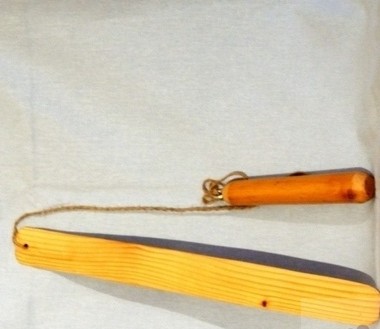
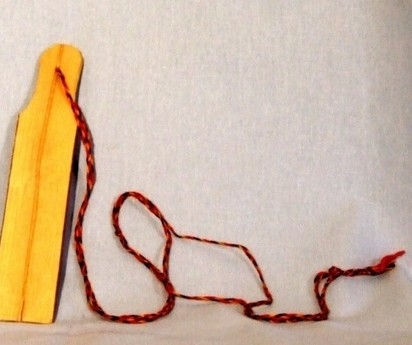
húkadlo
gondáš = Slovak swineherd.
Slovak swineherds drove their pigs with a whirling board. The húkadlo is a flat slat of wood a hand or two long, its edges sharpened, sometimes notched or painted, on a cord about a metre long. Swung round the head, its edge cuts the air with a hooting, deep, mysterious note that wavers as the swing speeds and slows. The gondáši, the pig-herders, used it to move their animals; boys played with it in the meadows and out at pasture, and swung it to make a sound that frightened.
Particulars
- Object
- A flat wooden board 10–30 cm long and 5–8 cm wide, sharpened along its edges and tied to a cord of 80–100 cm; the edges may be notched or the board painted.
- Function
- Swineherds, especially the gondáši, whirled it to drive pigs; boys played with it in the meadows and at herding, or sounded it to make an eerie noise.
Source
Oskár Elschek, "húkadlo", Encyklopédia tradičnej ľudovej kultúry Slovenska (ludovakultura.sk, 2017); after Elschek, Slowakische Volksmusikinstrumente (Leipzig, 1983)