No. ELMENDORF1960-001
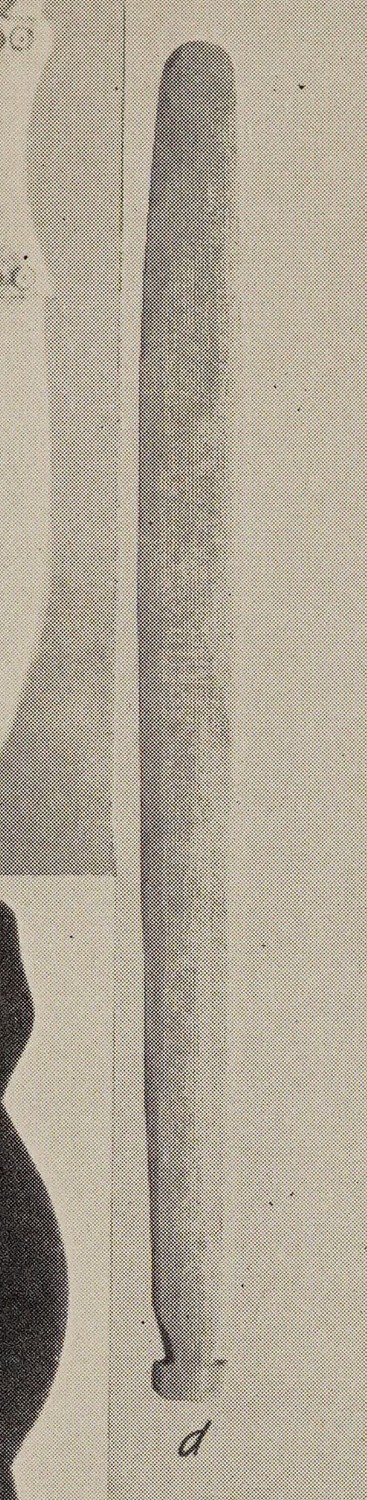
Twana rain-bringing bullroarer
United States · Hood Canal · Skokomish River, Puget Sound region, Washington · North America · Northwest Coast
Play / practical
Source term: bullroarer
Twana boys on Hood Canal had two ways to make the air sing, and both, it was said, could bring rain. One was a perforated astragalus bone on a doubled cord, twisted and pulled taut at both ends until it buzzed. The other was a long, flat, elliptical blade of cedar, corded to a stick handle and whirled around the head — a boys' plaything, kin to the tops, canoes and popguns of a Twana childhood on the water, and the one that called up the south wind.
It had no adult use nor any ceremonial association. Its use was, however, believed to bring south wind and accompanying rain, particularly in hot weather.
Elmendorf 1960:227
Particulars
- Object
- Flat, long, elliptical blade of cedar, perforated at one end for a cord tied to the end of a stick handle.
- Function
- A boys' plaything, believed to bring south wind and rain in hot weather.
Source
William W. Elmendorf, The Structure of Twana Culture (Washington State University Research Studies, Monographic Supplement 2, 1960), p. 227