No. DAMRAK2024-001
Amsterdam Damrak rib snorrebotten
Netherlands · Amsterdam · Damrak · Noord-Zuidlijn excavation · Europe · Low Countries
Function not recorded
snorrebot
Source term: snorrebot / bullroarer
snorrebot: Dutch 'whirring bone,' from snorren, to whirr or buzz, and bot, bone — the standard Dutch name for these rib blades.
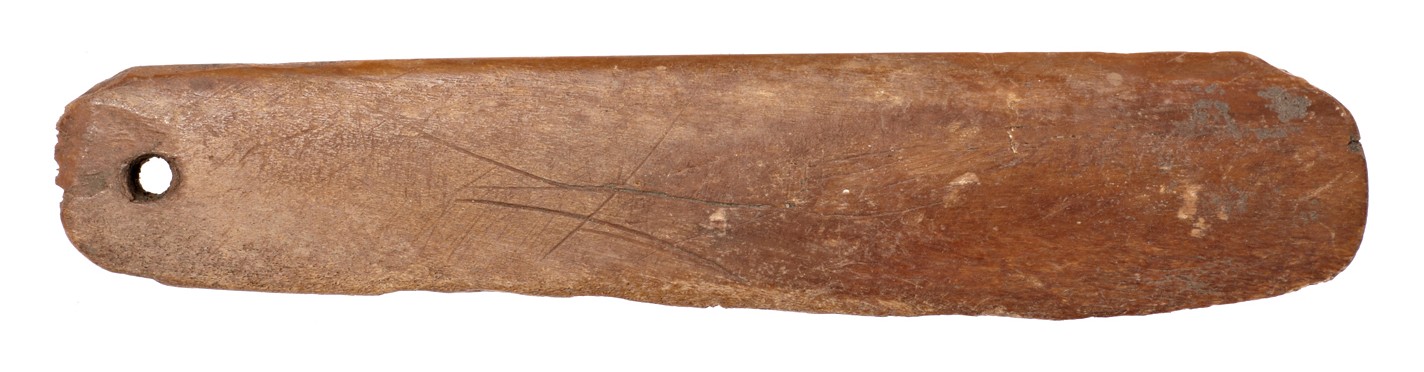
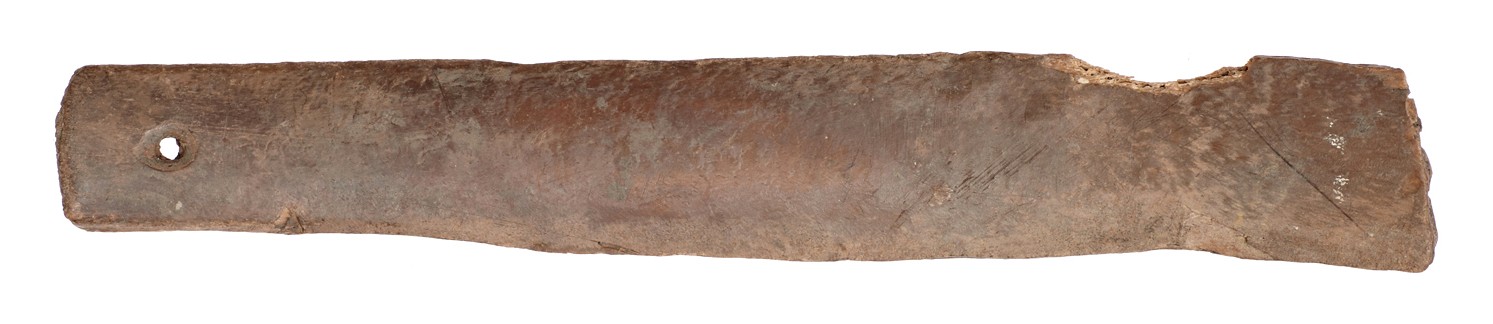
Butchers' waste, recut for noise: a cattle rib pared flat, pierced at one end, knotted to a cord and swung until the blade spun on its own axis and whirred — a snorrebot, a whirring bone. Six came out of a single deposit in the bed of the Amstel at the Damrak, opened up for Amsterdam's north–south metro line, where soft sand and peat swallowed dropped things whole and kept bone from rotting. Four run 126 to 183 millimetres; one is scored with incised lines.
Particulars
- Object
- Six blades cut from cattle ribs, pared flat and pierced at one end; four run 126–183 mm long and 26–28 mm wide, and one is scored with incised lines.
- Function
- Whirled on a cord fixed at one end to produce a whirring roar; no social use recorded.
Source
Rijkelijkhuizen 2024 §13.3, Fig. 139, cats. 167–170