No. AMKREUTZ2023-001
Tilburg-Kraaiven Late Mesolithic zoemsteen
Netherlands · North Brabant · Tilburg-Kraaiven · Europe · Low Countries
Function not recorded
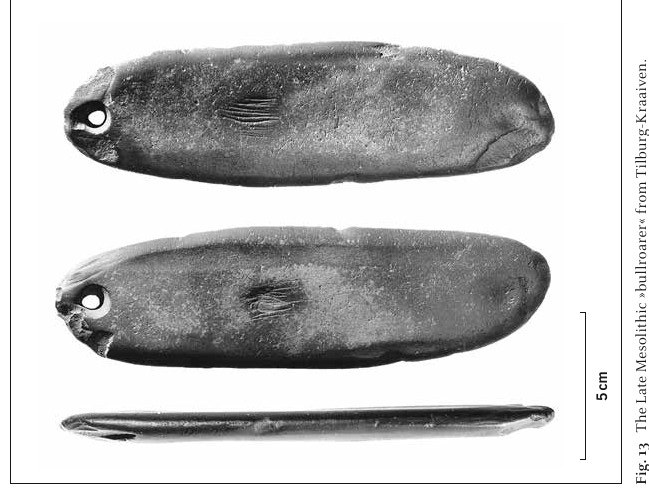
zoemsteen
Source term: zoemsteen (Dutch popular name); published as 'bullroarer'
zoemsteen — Dutch, 'buzz-stone'; the popular name for the Tilburg object in Brabant heritage writing.
On the northwest edge of Tilburg, a Late Mesolithic settlement yielded a thin plate of lydite fifteen and a half centimetres long, with a neat biconical hole drilled through one end. Wear above the hole records long suspension on a cord, while both faces carry rows of deliberate scratches. Dutch archaeologists publish it as a bullroarer—the zoemsteen, or ‘buzz-stone’—and Brabant heritage writing calls it perhaps the province’s oldest musical instrument. Its settlement context places it about 7,500 years ago.
Traces of wear above the perforation indicate the piece was suspended for a prolonged period of time.
Amkreutz & Niekus, Tagungen des Landesmuseums für Vorgeschichte Halle 26 (2023), p. 65
Particulars
- Object
- Thin elongated plate of lydite, 155 mm, with a biconical perforation at one end; wear traces above the perforation show prolonged suspension, and both flat faces carry series of 'scratches'.
- Function
- Published as a bullroarer: a terminally perforated stone blade whose cord wear records prolonged suspension.
Source
L. Amkreutz & M. Niekus, 'The Dutch Masters? Art, decoration and ornaments in the Late Palaeolithic and Mesolithic of the Netherlands', Tagungen des Landesmuseums für Vorgeschichte Halle 26 (2023), p. 65 and fig. 13, after Arts 1987; Jan van Oudheusden, 'Een zoemsteen', Erfgoed Brabant (14 March 2018)