EUROPE-011 - ethnographic attestation
Venetian and Friulian rural folk, north-eastern Italy
Province Venete and Friuli (Veneto and Friuli-Venezia Giulia regions, north-eastern Italy) - Southern Europe (NE Italy)
Sacred / spirit
rombo Italian
rombo - Italian for 'rumble/drone,' the standard Italian name for the bullroarer.
Etymology. Italian rombo continues the classical term for a spinning, whirring noise. (medium confidence)
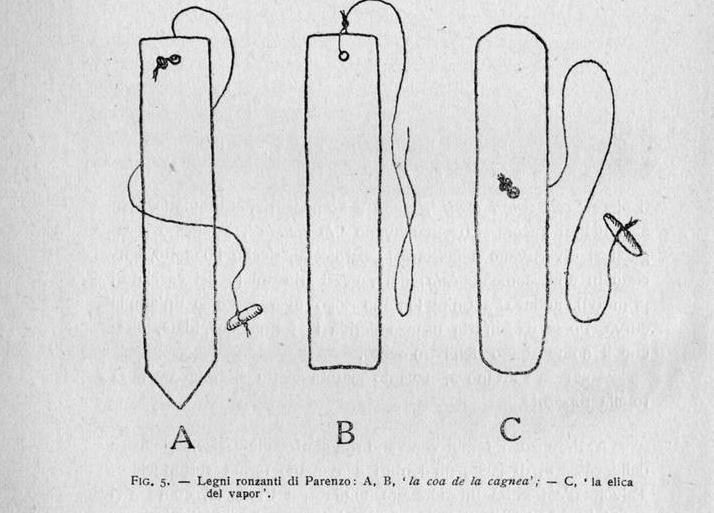
In the farming country of Veneto and Friuli, the bullroarer survived into the twentieth century as a rural plaything. The Italians call it the rombo: a flat wooden slat tied to a cord and swung overhead until it droned. In 1925 the ethnographer Raffaele Battaglia gathered the region's surviving examples into a dedicated study for the history-of-religions journal Studi e Materiali, illustrating seven specimens and arguing that this humble noise-maker was the worn-down descendant of one of humanity's oldest sacred instruments. What he found in the Venetian provinces, though, was not a rite but a remnant: a buzzing toy in the hands of country children.
Da questa sua originaria santità e sacralità originaria il rombo scade gradualmente fino a diventare uno strumento magico in mano a qualche strega o stregone, oppure un semplice giocattolo in mano ai ragazzi.
From this its original holiness and original sacredness the bullroarer declines gradually until it becomes a magical instrument in the hand of some witch or sorcerer, or else a simple toy in the hands of children.
Raffaele Pettazzoni, "Rombo," Enciclopedia Italiana (Treccani), 1936.
- Object
- A flat wooden slat (Italian assicella) of varying shape and size, pierced or notched at one end and tied to a cord, whirled overhead to produce a deep, droning hum; not the scraped cog-rattle (raganella) of the same region. Battaglia's monograph illustrates seven actual specimens collected in the Venetian provinces.
- Function
- A folk survival of the bullroarer: by the early 20th century a rural noise-maker and children's toy, the degraded remnant of a once-sacred whirling instrument.
- Map confidence
- medium - approximate territory centroid (combined Veneto-Friuli plain, NE Italy)
- Source location
- Battaglia 1925, SMSR 1: 190-217 (with 7 figures of specimens); pull-quote from Pettazzoni, "Rombo," Treccani (1936)
- Toy / secular survival