No. BLIER2015-001
A hidden voice on an Ife pot
Nigeria · Ile-Ife, Osun State · West Africa
Function not recorded
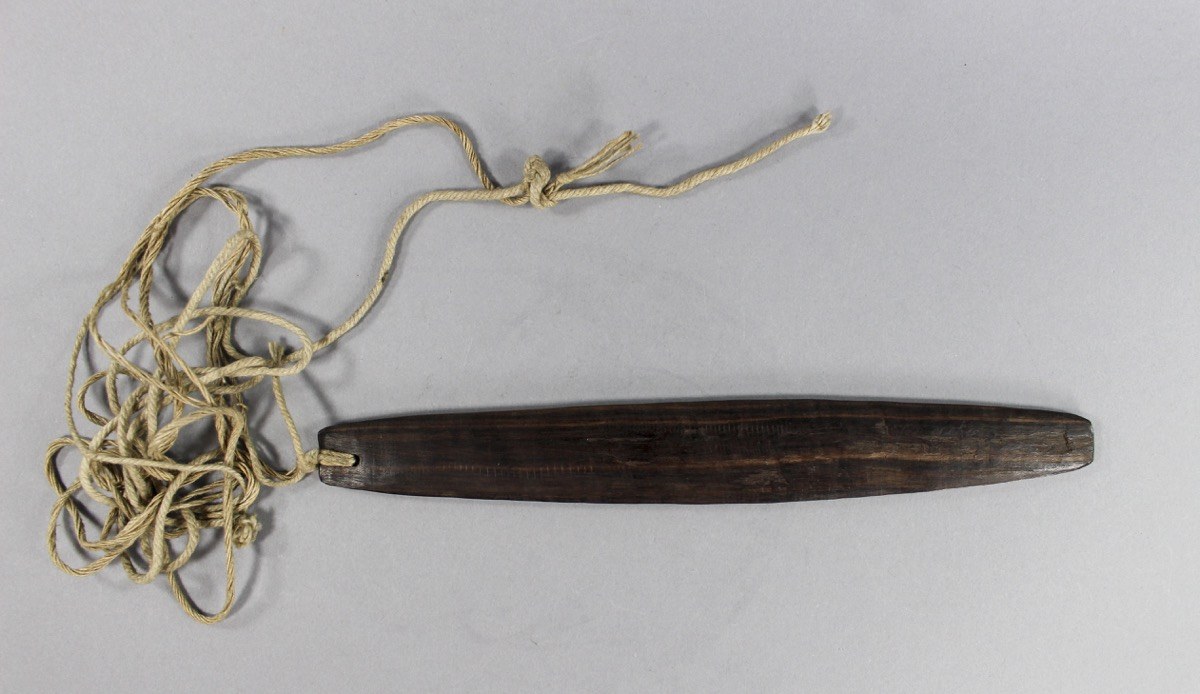
Source term: bull-roarer; bullroarer
Orò (“fierceness”): the executive branch of the Ogboni society, identified today with bullroarers. Ogboni: the Yoruba society of elders with judicial authority.
Wood rots in Ife's soil; fired clay keeps its shape. Around 1300, in the ancient Yoruba city, potters made globe-shaped vessels and covered them in relief: shrines, drums, knives and whips, leopards and snakes, severed heads, the staffs of the Ogboni elders. Some were set into the earth at shrines, one beneath a potsherd pavement with only its small mouth showing, perhaps to receive medicines or offerings. One of these vessels carries a bullroarer, the cord-swung wooden blade that in later Yoruba towns announced Orò, Ogboni's fierce enforcers, whose nighttime roar kept every household behind closed shutters.
A bullroarer of this type is shown on one of these vessels.
Suzanne Preston Blier, Art and Risk in Ancient Yoruba (2015), p. 149
Particulars
- Object
- A bullroarer shown in relief on one of ancient Ife's globe-shaped, narrow-mouthed terracotta ritual vessels; the particular vessel is not specified.
- Function
- Not recorded for the ancient instrument; in later Yoruba practice the bullroarer is the voice of Orò, the executive branch of Ogboni.
Source
Suzanne Preston Blier, Art and Risk in Ancient Yoruba: Ife History, Power, and Identity, c. 1300 (Cambridge University Press, 2015), pp. 102, 140, 146–147, 149