Atlas Essay — 2026-10-03
The Goddess Under the Men’s House
Ekoi · southeastern Nigeria · Nimm and Egbo
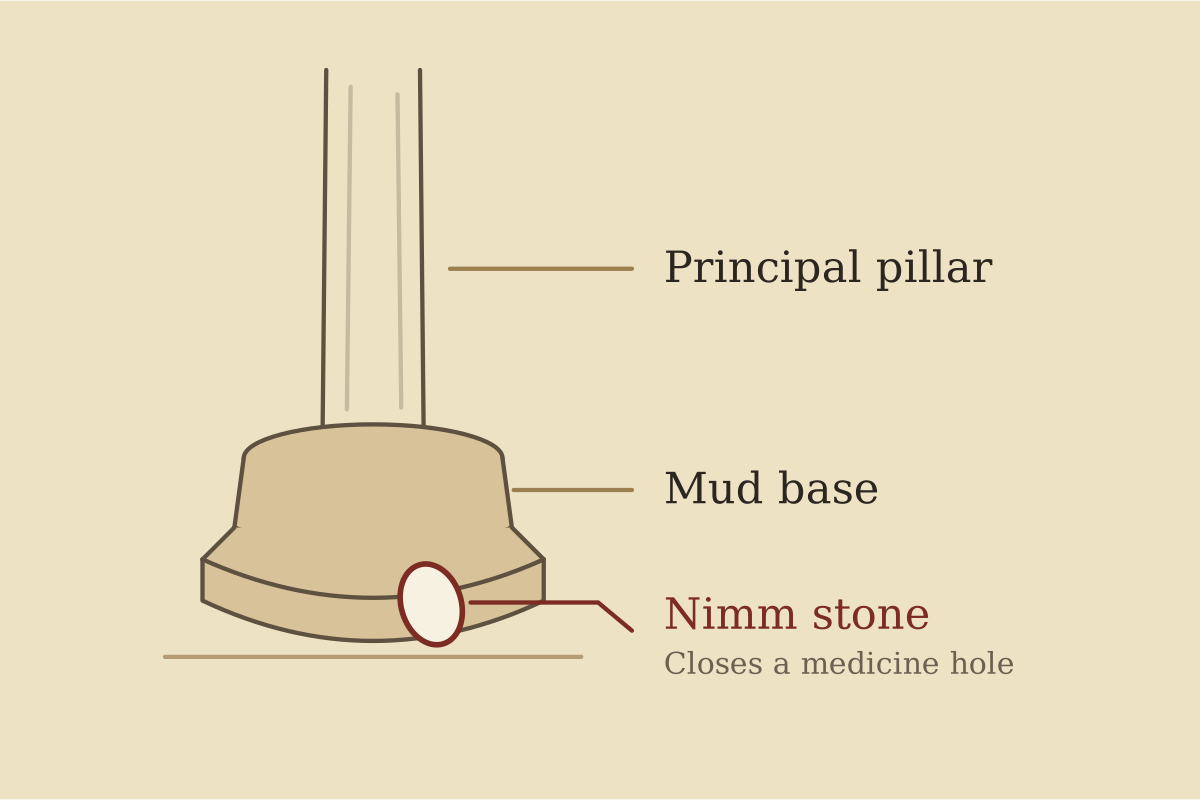
In the ruined town of Mkpott, a women’s goddess occupied the base of a men’s house. P. Amaury Talbot, travelling through the Ekoi country of southeastern Nigeria in the early twentieth century, found a Nimm stone in the mud surrounding an Egbo house’s great end pillar. The stone closed a small hole. Inside was medicine intended to bring the townspeople many children. The inhabitants had already dispersed into smaller settlements; their house still held this arrangement of sacred power. A building belonging to the men’s society carried, at the foot of its principal pillar, an object sacred to the women’s goddess.[1]
Among the Ekoi, Nimm’s sacred stones entered men’s houses while women kept a religious authority of their own.
In brief
- Among the Ekoi, Nimm’s sacred stones entered men’s houses while women kept a religious authority of their own.
- Nimm’s priestesses had their own initiations, shrines, divination and sacred day. Men were excluded from her mysteries.
- Some male clubs kept bullroarers secret from women. Nimm’s stones in Egbo houses served the town’s fertility.
- Women mudded and decorated the clubhouse walls; a prosperous mother could pay her son’s admission fees. Male ritual privilege belonged within a larger world of women’s work and power.
Nimm had a day of her own
Nimm belonged to the river. She could appear as a huge snake or a crocodile, and the animals that came down to drink and bathe were her servants. Talbot describes a goddess whom women could call upon against those who offended them. Her women’s society was powerful enough, in his account, to hold its own against Egbo. The two institutions appear together at the beginning of his book: the formidable men’s club and a women’s cult with power of its own.[2]
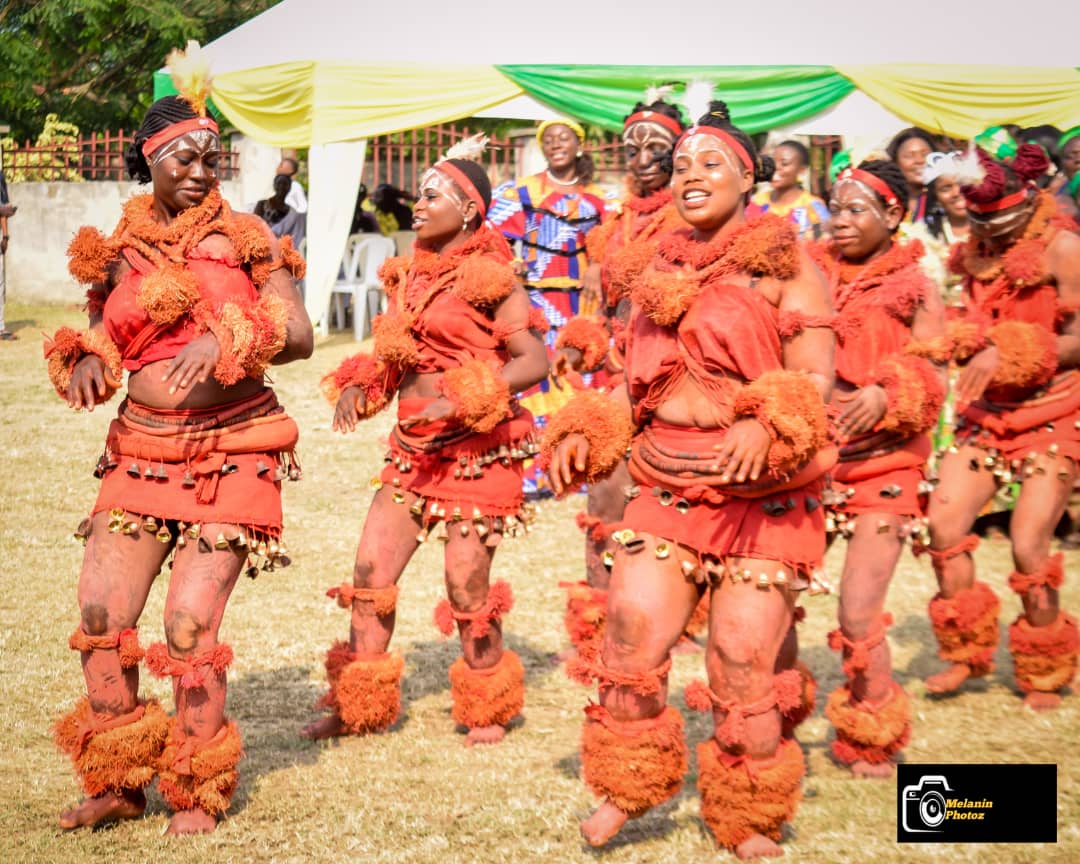
Every eighth day was sacred to Nimm. It was the women’s day, when their authority increased and work was forbidden. Farming on that day risked the goddess’s anger and the destruction of the offender’s crops by her animals. The observance gave women’s religion a place in the ordinary calendar. A town could organize its working life around a prohibition held in the name of a female power.[3]
Women entered her mysteries through initiation. New members were rubbed with red camwood dye. Initiation entitled them to particular ornaments and to carry Nimm’s feathers in the right hand and in the hair, with a ritual knife in the left. Talbot distinguishes an older rule of daily ceremonial dress from the practice of his time, when the knife and white feather were obligatory on ceremonial occasions. He is describing a continuing institution whose customs had changed.[3]
A Nimm woman kept a shrine in the corner of her room. An earthenware pot held the cult’s medicine; carved pieces of wood, corn cobs, a knife and white feathers accompanied it. For divination, white chalk was spread before the shrine and a small pile of white feathers burned upon it. The priestess studied the ashes for an answer. Women with a reputation for their oracles received particular respect. When a priestess gave a dance, townspeople brought roasted corn, palm oil and dried duiker meat.[3]
These were offices, possessions and obligations in the life Talbot described. Women entered Nimm’s mysteries; her priestesses gave answers and received offerings. Men were forbidden her mysteries. Talbot says even fear of death would not persuade an Ekoi man to intrude upon their celebration. Women’s secrecy had a boundary as well as a goddess. It operated alongside the men’s.[3]
Women made the walls
The Egbo house made male authority visible. Its pillars and decorated walls gave the society a place in the settlement. Yet the women who were excluded from its mysteries helped make the building itself. Talbot gives their part in its construction in a single compact description:
“Women mud the walls, which they decorate after smoothing but afterwards are never allowed to enter, save for cleaning purposes.”
Talbot, In the Shadow of the Bush, p. 265.[4]
The distinction is exact. Women worked on the surfaces through which the house presented itself to the town. Once the building was in use, they could enter to clean it. Admission to the men’s mysteries followed a different rule. The same woman could be necessary to the house’s material life and excluded from its ritual life.
Membership also required money. A wealthy family could pay a boy’s fees while he was still young. He became an honorary member, waiting until he was old enough for initiation. If his mother was richer than his father, she paid. A mother could therefore finance her son’s place in the institution whose mysteries she would not share.[5]
Her payment did not buy away the boundary. It helped reproduce it across generations. But the payment also places male privilege within a household economy in which a woman could command the greater resources. The club’s power, the mother’s wealth and the priestess’s office were different kinds of authority. An account that follows only the men through their initiation loses the people who furnished the walls, the membership and part of the sacred world around them.
The voice men kept
Some Ekoi clubs used the bullroarer, a blade turned in the air on a cord. Its sound could reach people who could not see the instrument. Talbot calls these objects Enyara Akum, associating their name with the dark, restricted things of the clubs. He says they had formerly been played only in secret, and that women were forbidden both to see them and to know what caused the sound.[5]
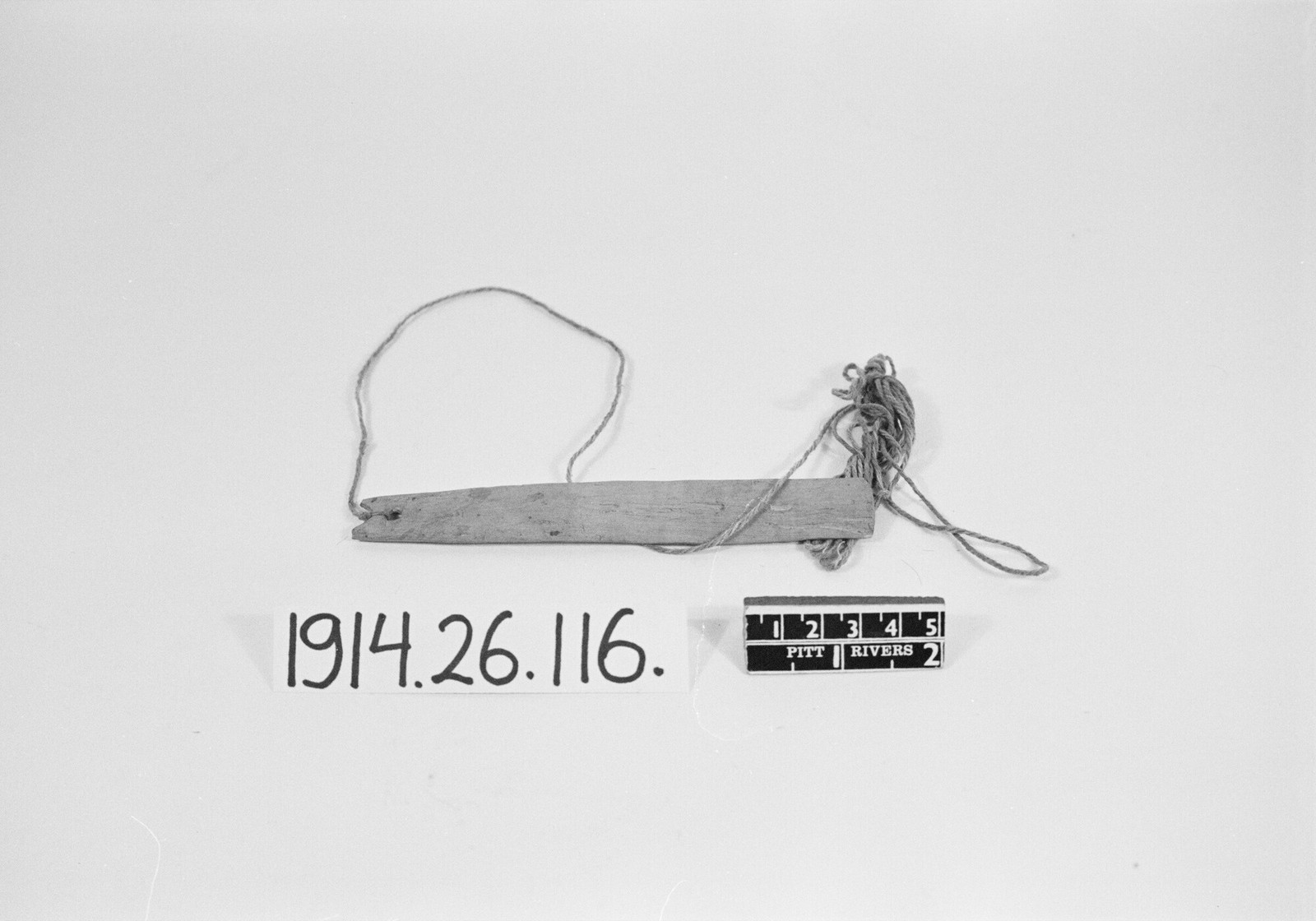
The secret concerned a practical cause: what a person could hold and move to produce the sound. Keeping the blade from sight made knowledge of that cause a privilege. A boy’s initiation could place him on one side of the division while his mother remained on the other. The cord and blade joined a larger system of fees, age, permission and concealment.
Talbot records club bullroarers and Nimm stones separately; he does not place a bullroarer in the Mkpott house or in Nimm’s rites. The connection lies in the relationship between institutions. Men guarded a sounding instrument, women guarded their own mysteries, and stones sacred to the women’s goddess entered the men’s architecture. Each fact gives the others a social setting.
The wider Ekpe society belongs to the Atlas’s history of secret voices. Nimm adds a second center of authority to the Ekoi account. To hear the men’s instrument against that background is to hear it within a town where women also had rites that men could not enter.
The river’s eggs entered the house
Water gave Nimm’s stones their shape. Talbot describes stones rounded into ovals by the river as sacred to her. Large ones, too heavy to move, remained where they stood and served as altars. Smaller ones, about the size of eggs, were collected and placed in compounds and farms. These were the “Eggs of Nimm,” associated with her serpent or crocodile form. Their purpose was fertility.[3]
The eggs carried the goddess into several kinds of inhabited ground. A field, a household compound and a clubhouse could each receive her stones. Talbot says that some were inserted into small holes in the mud base of the principal pillar of an Egbo house. The arrangement at Mkpott gives this general description a named place: a Nimm stone closed the hole containing medicine for the birth of children.[1][3]
Nimm also had a place in the making of a settlement. The site for the Egbo house was chosen early. A small hut without walls went up there, and Nimm stones were laid where the Etai Ngbe, the Leopard Stone, would later stand. When the permanent house was built, this long cut stone normally stood before the second pillar. Its erection brought chiefs together with food and palm wine, part for sacrifice and part for a shared meal. The egg stones and the Leopard Stone belonged to the ritual work of establishing a town.[4]
The goddess could appear on clubhouse surfaces as well. Talbot describes snake reliefs on the far walls of many Egbo houses and crocodiles carved on their principal pillars. At Abijang, his interlocutors offered several interpretations of the figures on a decorated wall. Nimm appeared in all the explanations he recorded, though the identity of each figure varied. A woman, a snake and a crocodile were among the forms through which she could be understood.[6]
A male institution could thus draw upon a female divinity for purposes larger than its membership. The fertility at Mkpott was the fertility of the townspeople. Children would become the next generation of households and, in time, the next members of the societies. Nimm’s presence reached beyond the women admitted to her mysteries. Her stones brought that reach into the house from which women were ritually excluded.
Key sources
All page numbers refer to P. Amaury Talbot, In the Shadow of the Bush (1912). Talbot’s account is a colonial-era description of Ekoi life: the Mkpott house is his reported observation; ritual purposes, prohibitions and divine identities include explanations he received. The essay concerns the practices described in that account, rather than present-day Ejagham religious life.
[1] Mkpott. Talbot, p. 219: ruined town, Egbo house, Nimm stone in the lowest circle of the pillar base, medicine for the birth of children.
[2] Nimm’s power. Talbot, pp. 2–3: river goddess, serpent and crocodile forms, women’s devotion and the strength of her society alongside Egbo.
[3] Women’s rites and Nimm’s stones. Talbot, pp. 94–96: sacred eighth day, initiation, household shrines, divination, offerings, egg stones and the exclusion of men.
[4] The making of the men’s house. Talbot, pp. 262–265: new settlement, Nimm stones at the future Leopard Stone’s site, clubhouse construction, women’s work and restricted access. Quotation on p. 265.
[5] Club membership and bullroarers. Talbot, pp. 283–284: admission fees, a mother’s payment, honorary membership before initiation, restricted use of Enyara Akum in some clubs.
[6] Clubhouse imagery. Talbot, pp. 24–25 and 216–217: snake and crocodile decoration; Abijang drawing and alternative explanations of its figures.