No. TAHA2016-001Near East
Halula pierced rib blade
Syria · Middle Euphrates valley, c. 150 km east of Aleppo; Pre-Pottery Neolithic B to Halaf · Near East · Levant
Function not recorded Candidate only
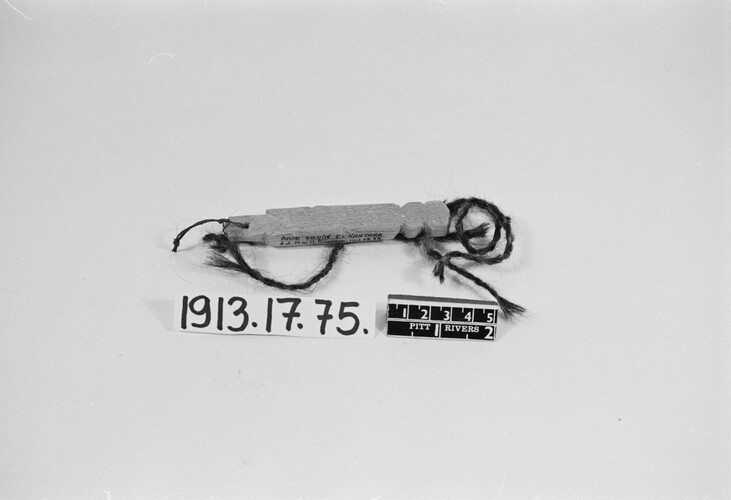
Source term: objeto perforado sobre costilla (pierced rib object)
In one house at Tell Halula, on the Middle Euphrates, someone painted the floor beside the hearth with twenty-three women in red, ranged around a square filled with lines. The village lasted some two thousand years. Its houses stood in rows, each with a large main room plastered in lime, and the dead were buried in that room's floor, near its door. Halula's bone-workers cut long, flat tools from the ribs of large animals, and a few of these they pierced at one end. This is the only one to survive whole: a strip of rib twenty centimetres long, barely two wide and five millimetres thick.
Particulars
- Object
- Long flat strip worked from the rib of a large mammal, pierced at its proximal end; complete, 200 mm long, 22 mm wide and 5 mm thick. The only complete one of six pierced rib objects from the site.
- Function
- Not recorded.
Source
Buchra Taha, Industria ósea en el Neolítico del Próximo Oriente: Estudio tecnológico y funcional del asentamiento de tell Halula (Valle del Éufrates, Siria), doctoral thesis, Universitat Autònoma de Barcelona (2016), pp. 50–59, 220–221