No. SOINUENEA2026-002Europe
Lezo whetstone burrunda
Spain · Lezo, Gipuzkoa, Basque Country (Oarsoaldea) · Europe · Iberia
Play / practical
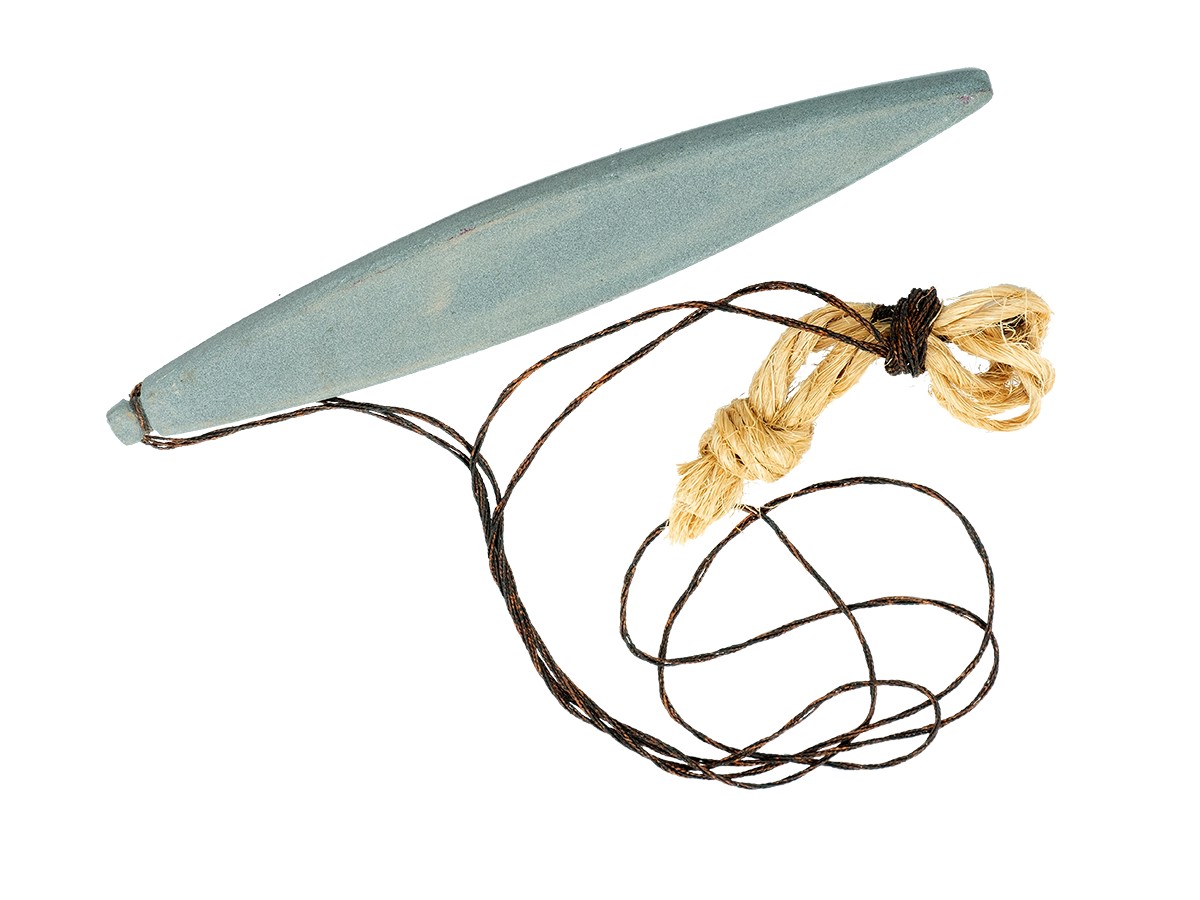
burrunda
burrunda: the Lezo name for the burruna, the Basque bullroarer.
Every scythe in the hay meadows of Gipuzkoa had its whetstone, a long narrow stone drawn along the blade to keep its edge. Mikel Salaberria, born in 1932 on the Martizkone farm at Lezo, turned one into a burrunda when he was about twelve. The stone could be tied to its cord in two ways: by boring a hole through one end, slow and stubborn work, or by cutting a notch for the string to bite. He played it on his own, never with a group.
Harria sokarekin bi modutan lotzen omen zen: mutur batean kostata zuloa eginda edo bestela koska bat eginez.
The stone was tied to the cord in two ways: by boring a hole at one end, which took some doing, or else by cutting a notch.
Soinuenea, Euskal Herriko soinu-tresnen entziklopedia, “Burruna” (Mikel Salaberria, recorded by Juan Mari Beltran, 2010)
Particulars
- Object
- A scythe whetstone tied to a cord, either through a hole bored with difficulty at one end or in a notch cut for it; reconstructed to Mikel Salaberria’s description in 2010 (JMB 1432).
- Function
- A boy’s sound toy, played alone; Salaberria played it at about twelve, in the 1940s.
Source
Soinuenea Herri Musikaren Txokoa, Euskal Herriko soinu-tresnen entziklopedia, “Burruna” (Basque text). Mikel Salaberria testimony, Lezo, 2010.