No. SERVIER1970-004
Sinhalese runa procession toy
Sri Lanka · Ceylon · South Asia
Play / practical
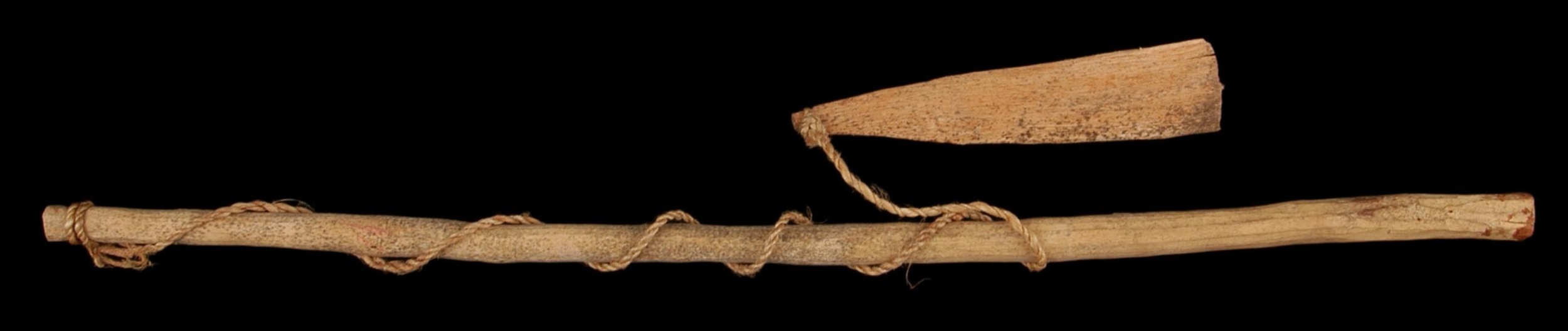
Source term: rombo
runa — the Sinhalese children's name Seligmann recorded for the whirled wooden slat at Colombo. The companion cattle-scarer is the kotipetta (koti, cheetah; petta, a thin slip of wood) or helibambara of Perera's note.
Boys followed Colombo’s Perahera procession with runa whirring above their heads. In Kandy, children supplied a sharper sound by cracking whips. The runa also belonged to ordinary play: children swung roughly cut wooden blades on sticks near Colombo, while children at Anuradhapura had neater bamboo versions. Boys also used a bamboo kotipetta to keep cattle out of the paddy fields, its growl likened to a cheetah.
I was informed that at Colombo a troop of boys whirling these toys, called runa, followed the Perahera procession (a ceremony in the great Buddhist festival held annually about the end of May). This is not done at Kandy, their place being taken by boys' cracking whips.
C. G. Seligmann, "The Bull-Roarer in Ceylon," Folklore 11 (1900)
Particulars
- Object
- A thin oblong slip of wood or bamboo, tied by string or kitul fibre to a stick and swung rapidly round.
- Function
- Children’s toy sounded by boys following Colombo’s Perahera procession.
Source
C. G. Seligmann, 'The Bull-Roarer in Ceylon,' Folklore 11 (1900), p. 456; A. A. Perera, 'A Sinhalese Toy,' Spolia Zeylanica 8 (1912), p. 147, note 22; Jean Servier, El hombre y lo invisible (Spanish trans. of L'homme et l'invisible), p. 138