No. SASIA-009
Sinhalese runa whirring toy
Sri Lanka · Ceylon (Colombo, Anuradhapura) · South Asia
Play / practical
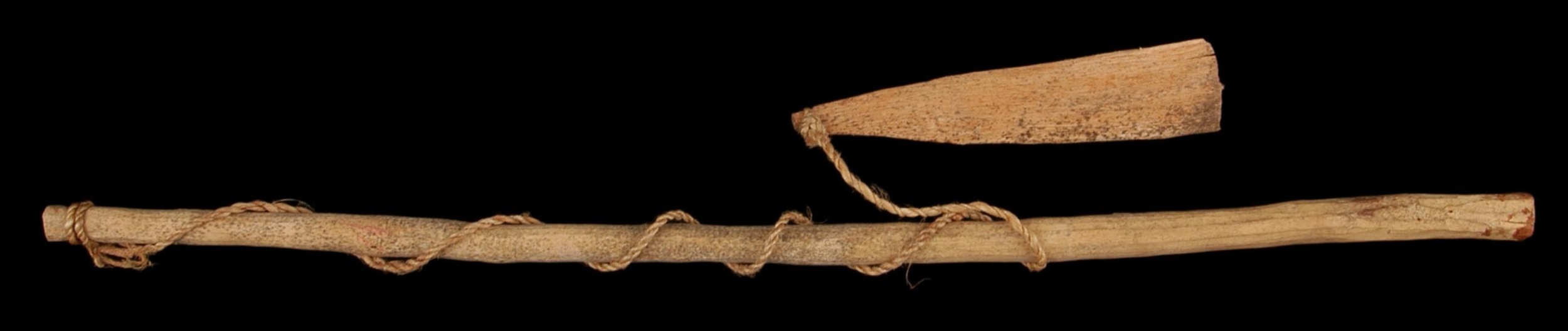
runa
runa — the Sinhalese children's name Seligmann recorded at Colombo; he gives no further meaning.
Children waved runa above their heads until the slats whirred. At Cotta near Colombo, Seligmann saw rough wooden versions driven by a cord and short stick; Anuradhapura children played with neater bamboo ones. He was told that a troop of boys also sounded them while following Colombo’s Perahera procession. At Kandy, boys supplied the noise by cracking whips instead. The same toy voice could fill an afternoon’s play or accompany a festival crowd.
I was informed that at Colombo a troop of boys whirling these toys, called runa, followed the Perahera procession (a ceremony in the great Buddhist festival held annually about the end of May). This is not done at Kandy, their place being taken by boys' cracking whips.
C. G. Seligmann, "The Bull-Roarer in Ceylon," Folklore 11 (1900): 456
Particulars
- Object
- Roughly quadrilateral wood slat (~137x40mm; also neater bamboo specimens), holed at one end on a string, waved overhead to make a whirring noise.
- Function
- Children's toy, also whirled by boys following Colombo's Perahera procession; elsewhere on the island boys swung a like toy, the helibambara, to keep cattle off the paddy fields.
Source
C. G. Seligmann, The Bull-Roarer in Ceylon, Folklore 11 (1900), p. 456: observed children’s play at Cotta and Anuradhapura, reported Colombo Perahera procession; Arthur A. Perera, A Sinhalese Toy, Spolia Zeylanica 8 (1912), p. 147, note 22, separately documents cattle-scaring and helibambara/kotipetta names