No. SEA-010
Narom bullroarer, Lower Baram, Sarawak
Malaysia · Sarawak · ?Narom · Southeast Asia · Borneo
Play / practical
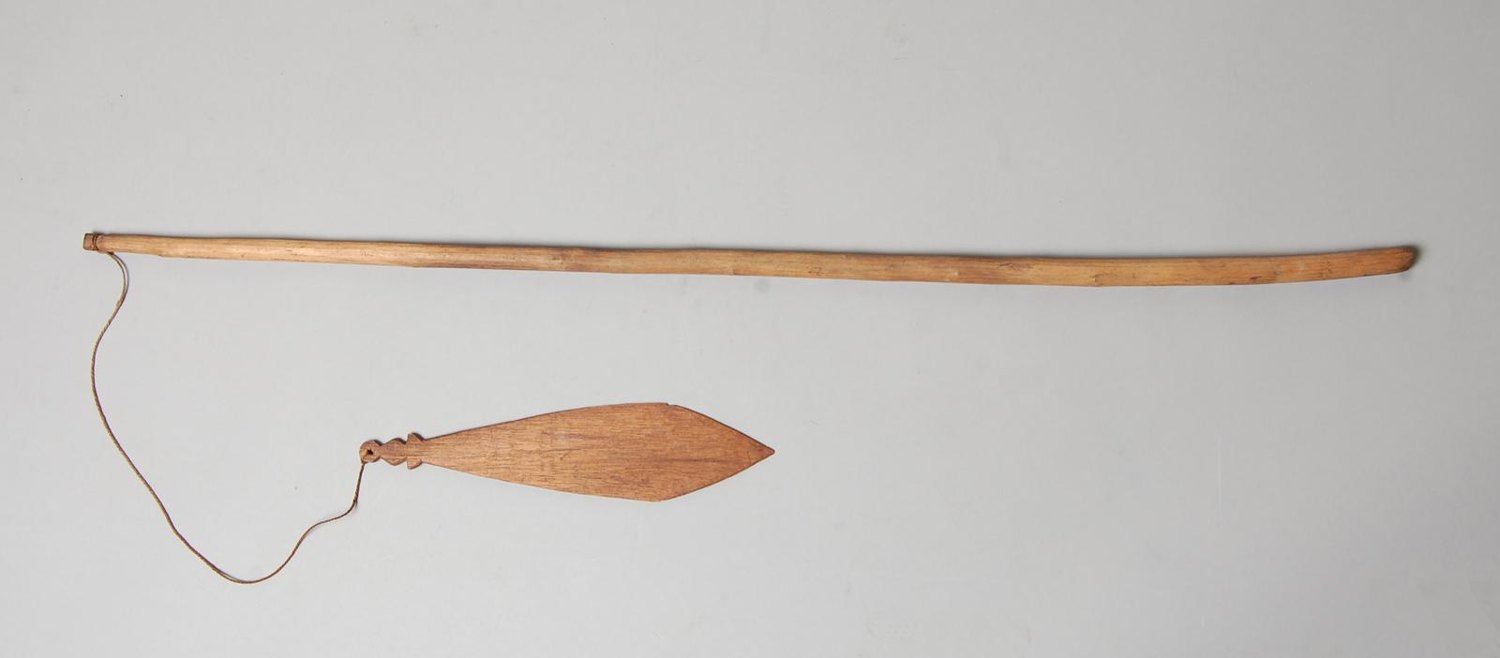
Source term: Bullroarer
On Borneo the bullroarer earned its keep in the rice fields. Charles Hose first came upon one in a Kenyah house up the Tinjar River and was told it was swung to scare birds off the padi; when he showed his find to the Narom, a small people of the lower Baram near Claudetown (today's Marudi), they knew the instrument well, used it often, and made him several to order — flat spear-head-shaped blades with two projecting 'ears' at the corded end, whirled from a stick nearly a metre long. The slat here, lashed to its stick, was collected by the Cambridge anthropologist Alfred Cort Haddon.
Dr. C. Hose first discovered the bull-roarer in Borneo in a Kenyah house up the Tinjar River, Baram district and was told that it was used to scare birds off the padi fields; Dr. Hose bought the unique specimen and subsequently showed it to some Narom, a tribe living near Claudetown, Baram River; the Narom stated that they were well acquainted with the instrument and frequently used it; they made several specimens to order.
R. Shelford, 'An Illustrated Catalogue of the Ethnographical Collection of the Sarawak Museum — Part I, Musical Instruments', Journal of the Straits Branch of the Royal Asiatic Society 40 (1904), pp. 58-59.
Particulars
- Object
- Cambridge MAA E 1916.142 A: a bullroarer attached to a stick.
Source
Museum of Archaeology and Anthropology, University of Cambridge, E 1916.142 A; R. Shelford, 'An Illustrated Catalogue of the Ethnographical Collection of the Sarawak Museum, Part I: Musical Instruments,' Journal of the Straits Branch of the Royal Asiatic Society 40 (1904), pp. 58-59, no. 1121