No. SEA-003
Kenyah Klemantan Baram wat jawat rice-field bullroarer
Malaysia · Sarawak · Baram River District · Southeast Asia · Borneo
Weather / fertility magic
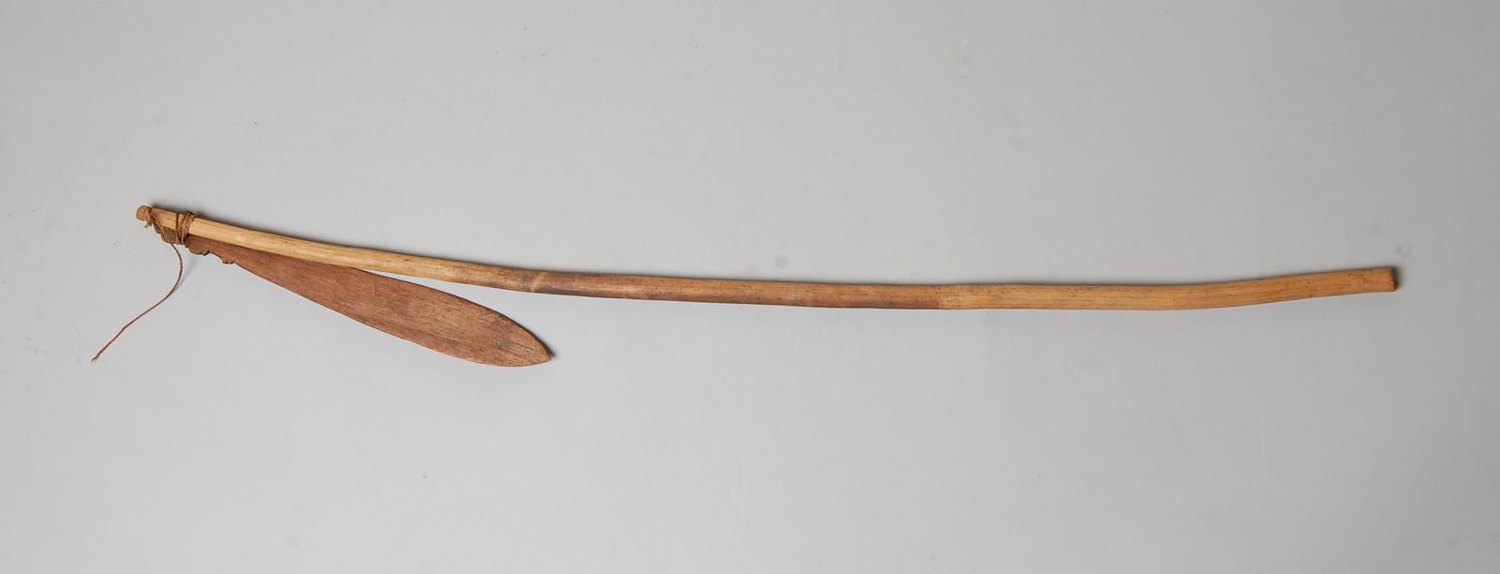
wat jawat
Source term: bullroarer
"wat jawat" — the Kenyah name for the bullroarer swung over the ripening rice.
When the rice began to ripen, Kenyah men went out into the fields and swung their wat jawat like lariats, all in unison, to frighten off the birds and the avian spirits that would attack the crop. Charles Hose, an officer in the Brooke administration of Sarawak, collected this small wooden bullroarer on the Baram River; it entered the British Museum in 1905, when the museum acquired his Borneo collection of some three thousand objects, and it is recorded as a child's toy of the Kenyah and Klemantan. In their account of Borneo, Hose and his collaborator William McDougall describe the instrument as a plaything of boys and tie it to the rice clearings: when jungle is felled for padi a few trees are left standing on high ground so as not to offend the local Toh, the spirits vaguely supposed to use the trees as resting-places, and on a pole lashed across such a trunk a bullroarer is sometimes hung "to dangle and flicker in the breeze."
Dr. C. Hose first discovered the bull-roarer in Borneo in a Kenyah house up the Tinjar River, Baram district and was told that it was used to scare birds off the padi fields
R. Shelford, 'An Illustrated Catalogue of the Ethnographical Collection of the Sarawak Museum, Part I: Musical Instruments', Journal of the Straits Branch of the Royal Asiatic Society 40 (1904), p. 59
Particulars
- Object
- A small wooden bullroarer on a string, recorded as a Kenyah and Klemantan child's toy.
- Function
- Scarer of birds and avian spirits from the ripening rice; also a children's toy.
Sources
- British Museum, object As1905,-.630 (Kenyah, Baram) View
- Hose and McDougall, The Pagan Tribes of Borneo (1912), vol. II, p. 23
- R. Shelford, 'An Illustrated Catalogue of the Ethnographical Collection of the Sarawak Museum, Part I: Musical Instruments,' Journal of the Straits Branch of the Royal Asiatic Society 40 (1904), p. 59