No. SEA-005
Kintak Bong bĕtaling, the tiger’s call
Malaysia · Perak · Ulu Selama · Lubok Tapah · Southeast Asia · Malay Peninsula
Restricted
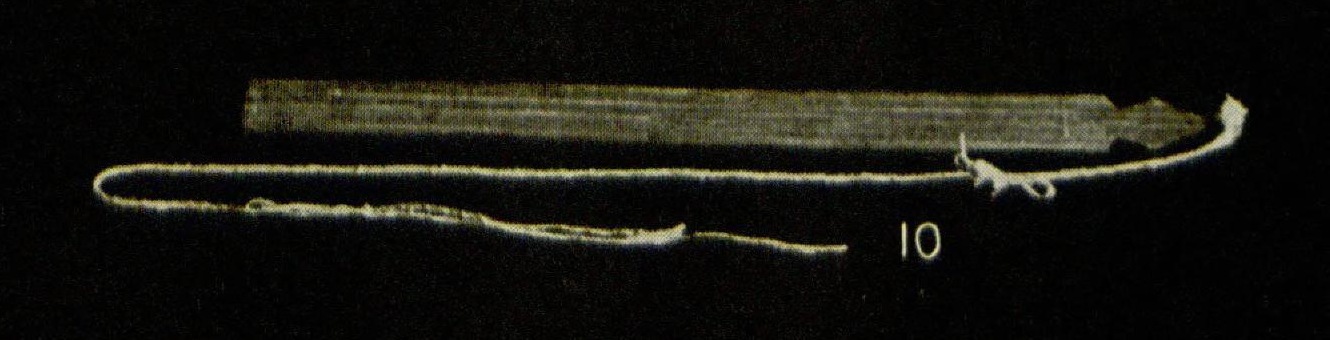
bĕtaling
Source term: bull-roarer
bĕtaling: the Kintak Bong bullroarer name given to Evans in 1935; he compared Malay bĕrbaling.
The bĕtaling was a children’s toy with a dangerous place to play. Sound it in the forest, the Kintak Bong said, and a tiger might come looking for the companion it thought it heard. At Lubok Tapah, headman Mempelam gave Ivor Evans another identity for the sound: the ghosts’ Jew’s-harp. The living Jew’s-harp, called genggong by Malays, was cut from bamboo or palm wood. Sounding the bĕtaling in the forest offended Kaei, the thunder god; beside Kaei lay Tanogn, a dragon or snake who roared thunder whenever an offence was committed.
The bull-roarer, of which I obtained a specimen at Lubok Tapah, is used as a toy by Kintak Bong children, but Mempelam told me that it is the ghosts' Jew's-harp.
Evans 1923:177
Particulars
- Object
- Specimen obtained by Evans at Lubok Tapah
- Function
- Forbidden in the jungle, where its sound offended the thunder god Kaei and drew a tiger. Otherwise a children’s toy, also called the ghosts’ Jew’s-harp.
Sources
- I. H. N. Evans, Studies in Religion, Folk-Lore, and Custom in British North Borneo and the Malay Peninsula (1923), p. 177 View
- I. H. N. Evans, The Negritos of Malaya (1937), pp. 120, 180, 267 View
- Paul Schebesta, “Religiöse Anschauungen der Semang über die Orang hidop (die Unsterblichen),” Archiv für Religionswissenschaft 24 (1926), pp. 225, 227, 232–233 View