No. MINE2026-082
Miau Baru Kayan buluq laluq wind bullroarer
Indonesia · Miau Baru, Kongbeng, East Kutai Regency, East Kalimantan · Southeast Asia · Borneo
Function not recorded
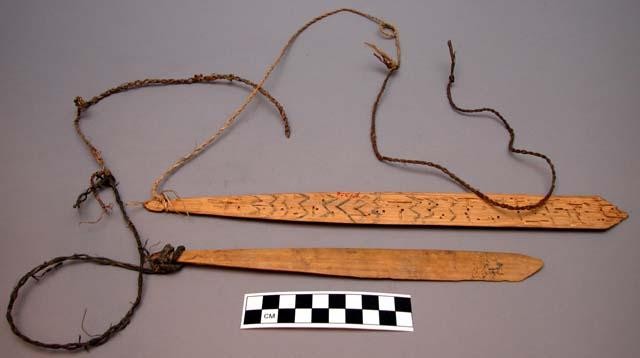
buluq laluq
Source term: bull roarer
buluq laluq: the Kayan Umaq Lekan name for the wind bullroarer.
Maceda heard about the buluq laluq at Miau Baru, a village founded in 1961 by Kayan Umaq Lekan migrants who had come down from the upper rivers, thirteen hundred people strong by his 1977 music workshop. His informants described it as a bullroarer of their own that the wind itself set going — listed apart from the pull-string clapper that guarded the rice fields, though no one played one for him. What the blade looked like, nobody recorded.
buluq laluq, a bull roarer agitated by the wind.
José Maceda, 'Report of a Music Workshop in East Kalimantan', Borneo Research Bulletin 10(2) (1978), p. 93.
Particulars
- Object
- Wind-driven bullroarer named buluq laluq.
- Function
- Not recorded.
Source
José Maceda, 'Report of a Music Workshop in East Kalimantan,' Borneo Research Bulletin 10(2) (1978), p. 93