No. SCHMIDT1925-001Near East
The ’ōb of the woman of En-dor
Israel · En-dor (Ein Dor), Lower Galilee · Near East · Levant
Sacred / spirit Candidate only
’ōb (Hebrew אוב), plural ’ōbōt
Source term: אוב; 'Schwirrholz', 'Bull-roarer' (Schmidt)
’ōb (אוב): Hebrew term at the centre of biblical necromancy, rendered 'familiar spirit' in the King James Version; Schmidt read it as the instrument itself. Schwirrholz: German, 'whirring wood', the bullroarer.
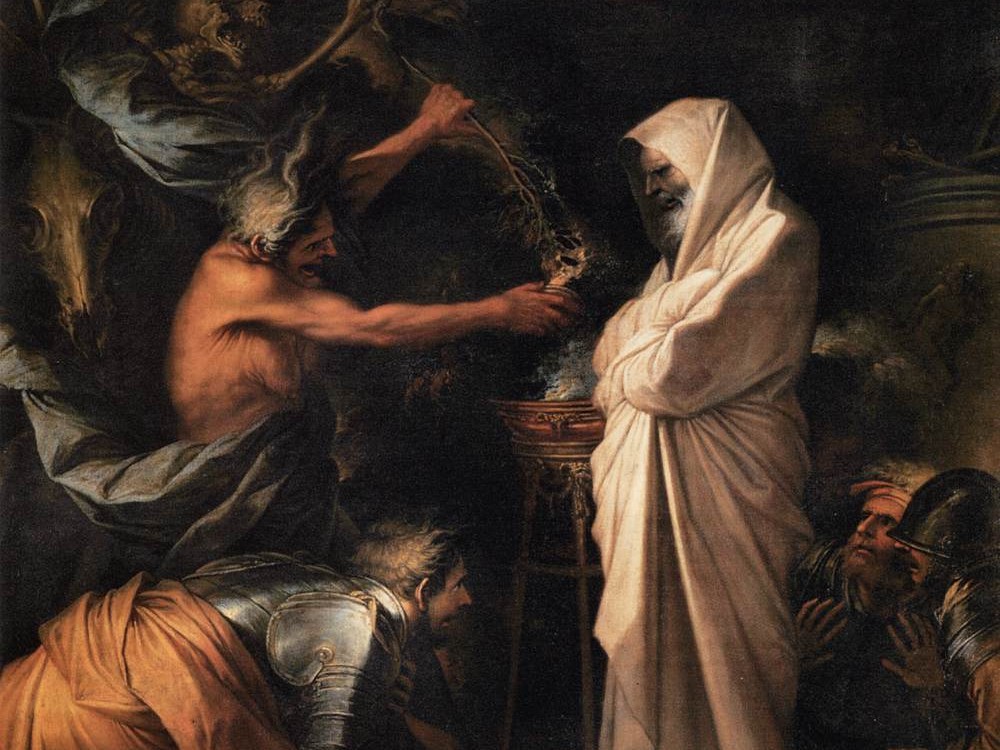
King Saul had driven the mediums out of the land. Then the Philistines massed at Shunem, and when God would answer him neither by dreams, nor by Urim, nor by prophets, Saul put on other clothes and went by night to a woman at En-dor who was mistress of an ’ōb. "Bring me up Samuel," he said. She cried out when she saw "gods ascending out of the earth": an old man covered with a mantle, who told the king that tomorrow he and his sons would be with him among the dead. The Hebrew ’ōb is usually translated 'familiar spirit' or 'ghost'. In 1925 the Old Testament scholar Hans Schmidt argued that it was a thing in the conjurer's hands, and that the thing was a bullroarer. Isaiah's mediums 'peep' and 'mutter', and he makes ruined Jerusalem speak 'as one that hath a familiar spirit, out of the ground'. That whistling and whirring, Schmidt wrote, is the sound of the dead.
Das ist der Ton der Toten.
That is the sound of the dead.
Hans Schmidt, 'אוב', in Vom Alten Testament (1925), p. 259
Particulars
- Object
- The ’ōb with which the woman of En-dor called up the dead, read by Hans Schmidt as a whirled blade on a cord.
- Function
- Raising the dead to question them: the woman of En-dor brought up the prophet Samuel for King Saul. Schmidt heard in the whistling and humming of the ’ōb the voice of the dead.
Sources
- Hans Schmidt, 'אוב', in Karl Budde (ed.), Vom Alten Testament: Karl Marti zum 70. Geburtstage gewidmet (Giessen, 1925), pp. 253-261 View
- 1 Samuel 28:3-25; Isaiah 8:19, 29:4 (King James Version)