No. SASIA-004
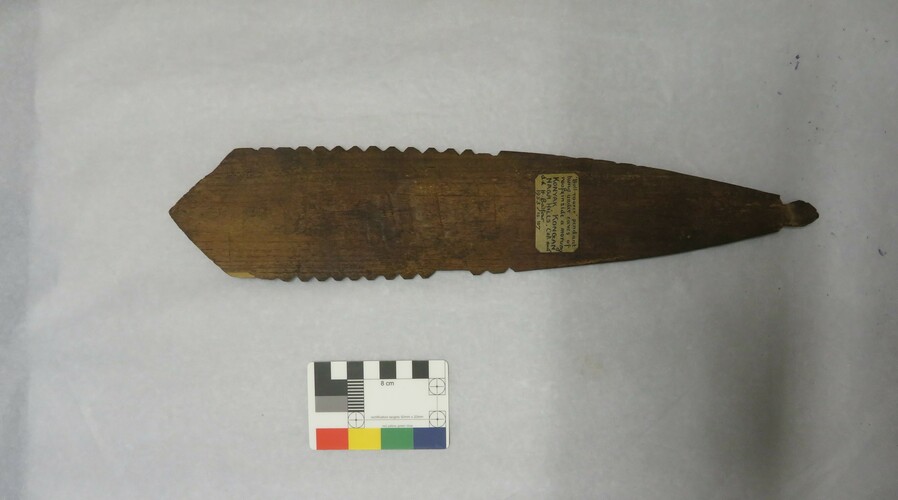
Chittagong notched blade
Bangladesh · Chittagong District · South Asia
Play / practical
Source term: Bull-roarer
A single bull-roarer in the Indian Museum is recorded as coming from the Chittagong District, but, as Sarat Chandra Roy noted in his 1927 survey, neither the exact place where it was found nor the use made of it was ever written down. The Chittagong piece, like the Santal one Roy had himself found in a Monghyr village, is notched rather than perforated to take its string. With no survey of Indian bull-roarers to draw on, Roy could set it only against the tribes he knew inland: among the Mundas, Hos, and Santals the instrument survived in a few villages merely as children's toys, while only among the Oraons did it keep a ceremonial, magico-religious life, with hundreds of thin bamboo slats threaded on strings hung in rows from the beams of bachelors' dormitories that it was a sin for women to enter. Of the Chittagong piece itself, Roy could record only its shape.
There is only one specimen of the Bull-roarer in the Indian museum, said to have come from the Chittagong District, but neither the exact place of find nor the use made of it has been recorded.
Sarat Chandra Roy, "The Bull-roarer in India," Man in India vol. 7 (1927), pp. 62-63
Particulars
- Object
- Single Indian Museum specimen said to come from Chittagong District
- Function
- A toy, in use among the Muslims of Chittagong.
Source
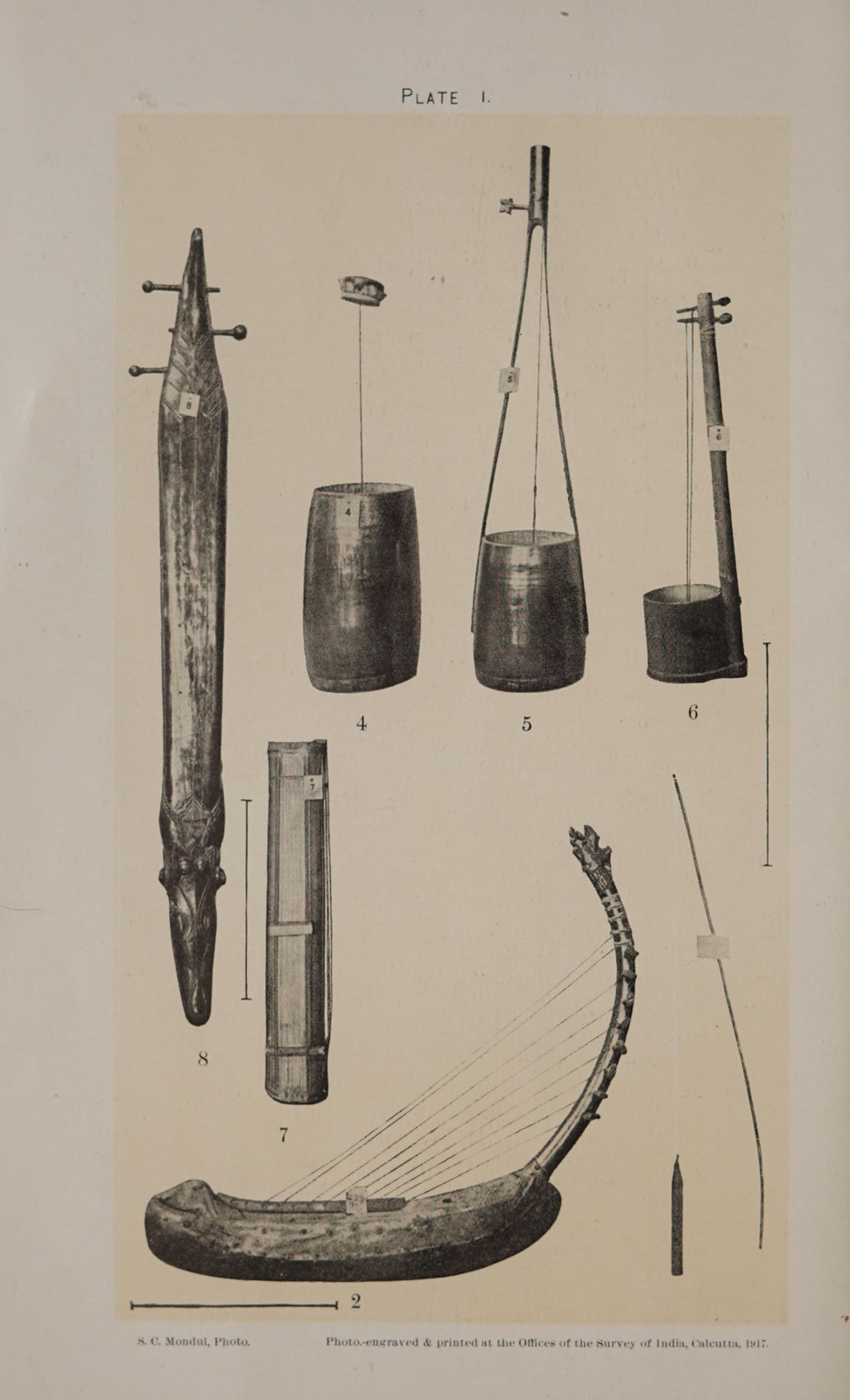
Sarat Chandra Roy, 'The Bull-Roarer in India,' Journal of the Bihar and Orissa Research Society 13(1) (1927): 54-61, summarized in Man in India 7 (1927), pp. 62-63; A. M. Meerwarth, A Guide to the Collection of Musical Instruments Exhibited in the Ethnographical Gallery of the Indian Museum, Calcutta (1917), p. 3; Indian Museum, Calcutta, reg. no. 11007