MUS2026-086 - museum specimen
Xavante bull-roarer (museum)
Brazil - Mato Grosso - South America
Function not recorded
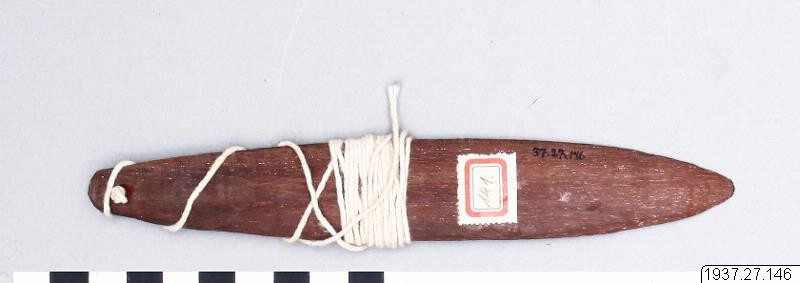
Source term: bull-roarer
A Xavante bull-roarer in Osaka's National Museum of Ethnology, catalogued as a humming sound-device — and a puzzle. The Xavante sound world was set down instrument by instrument in Desidério Aytai's O Mundo Sonoro Xavante, and the bull-roarer is not in it: in the wai'a, the men's great spirit ceremony, the voices of malevolent spirits come instead from rare insect-cocoon whistles that women must never see. Among the Sherente, the Xavante's closest kin, initiates did carry a roarer into forest seclusion to summon a spirit. For the Xavante themselves, this blade stands alone.
楽器(うなり音具)
Musical instrument (humming/droning sound device)
National Museum of Ethnology, Osaka (Minpaku), object record H0104028
- Object
- Bull-roarer of the Xavante, National Museum of Ethnology, Osaka (Minpaku).
- Function
- Not recorded — and conspicuously absent from Aytai's dedicated catalog of the Xavante sound world; in the wai'a the voices of malevolent spirits come from insect-cocoon whistles taboo to women, not from the roarer (Aytai 1985).
- Map confidence
- high - approximate culture/locality centroid
- Source location
Page references
object record H0104028 (Minpaku)