No. PEUR2026-010
Loughcrew Cairn H perforated bone slips
Ireland · Co. Meath · Sliabh na Caillí (Loughcrew), Carnbane West; Iron Age deposit in a Neolithic passage tomb · Europe
Function not recorded Candidate only
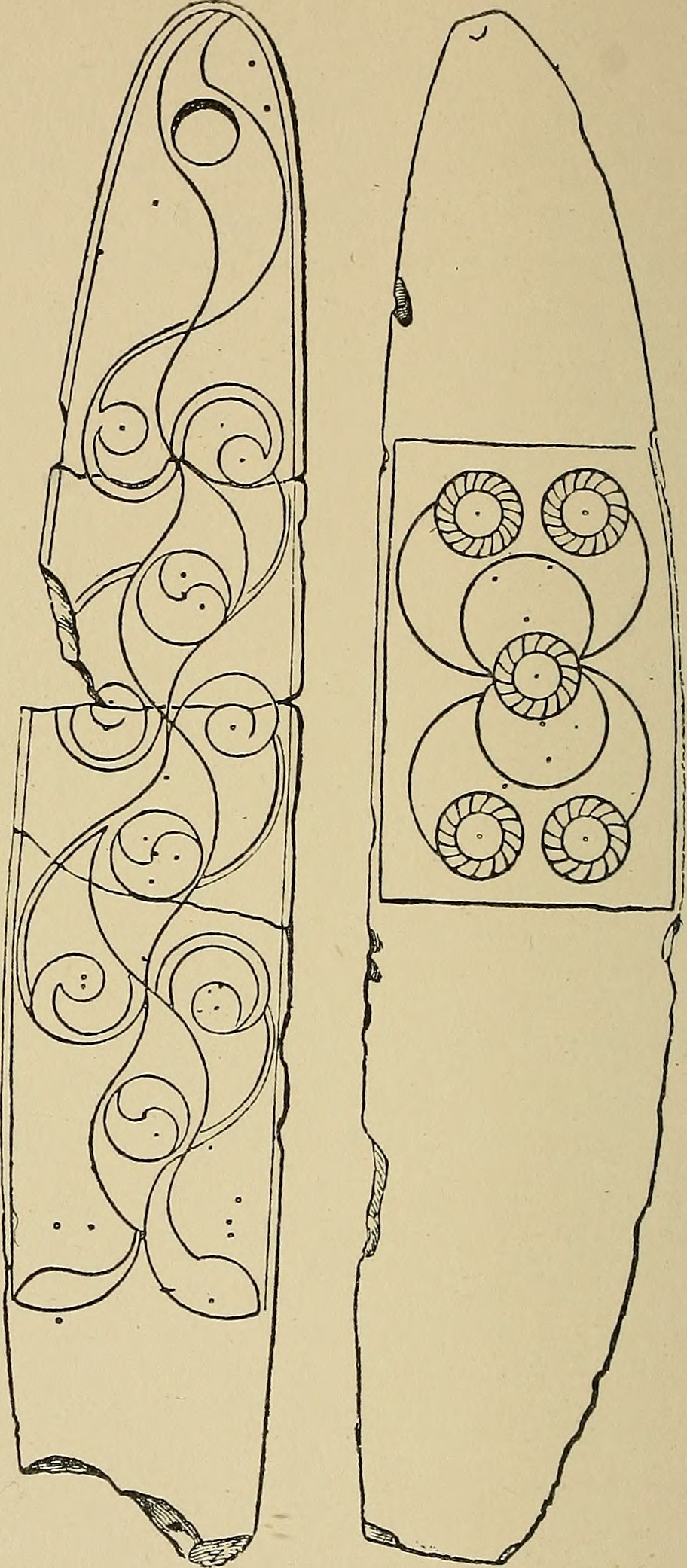
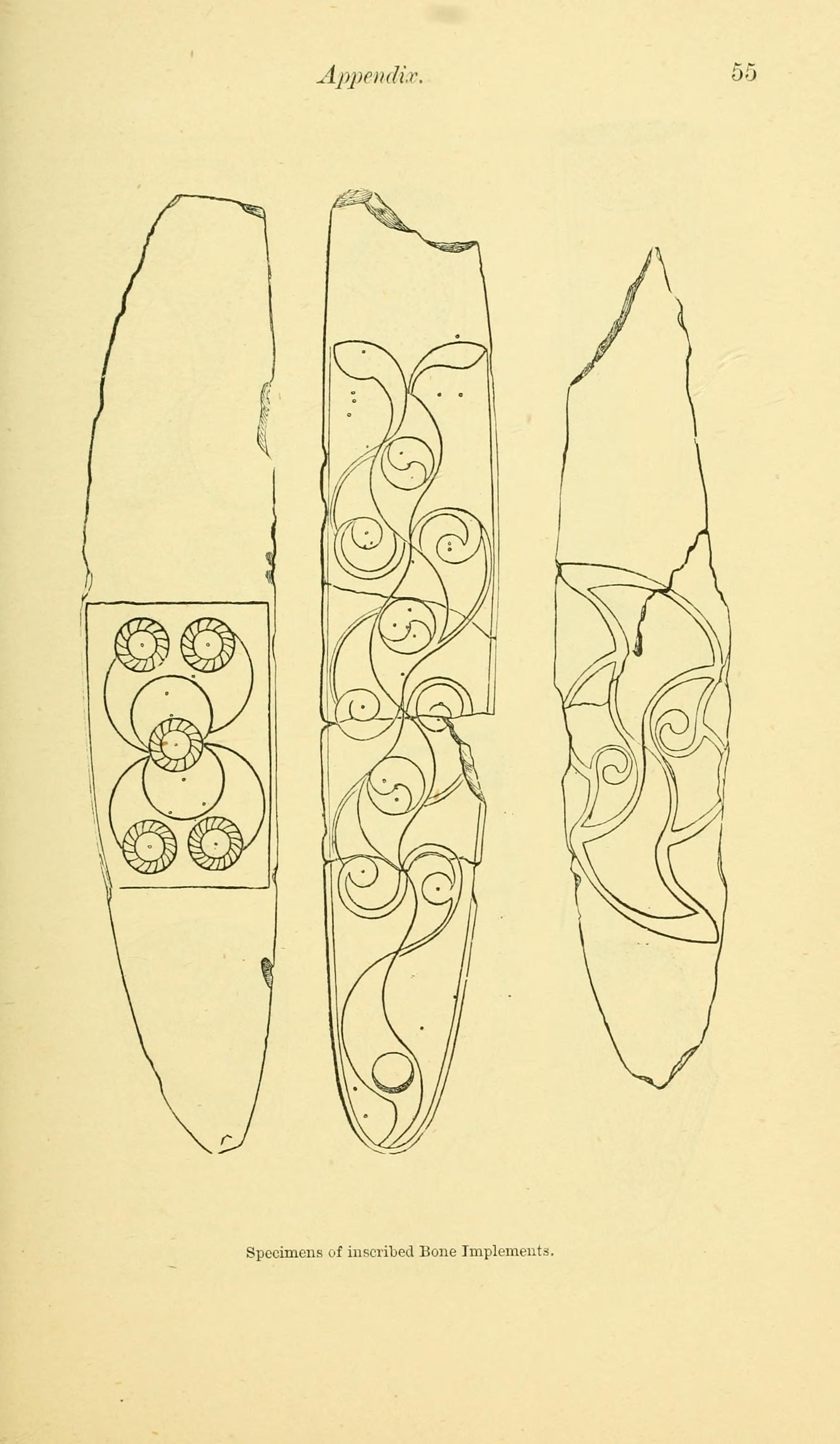
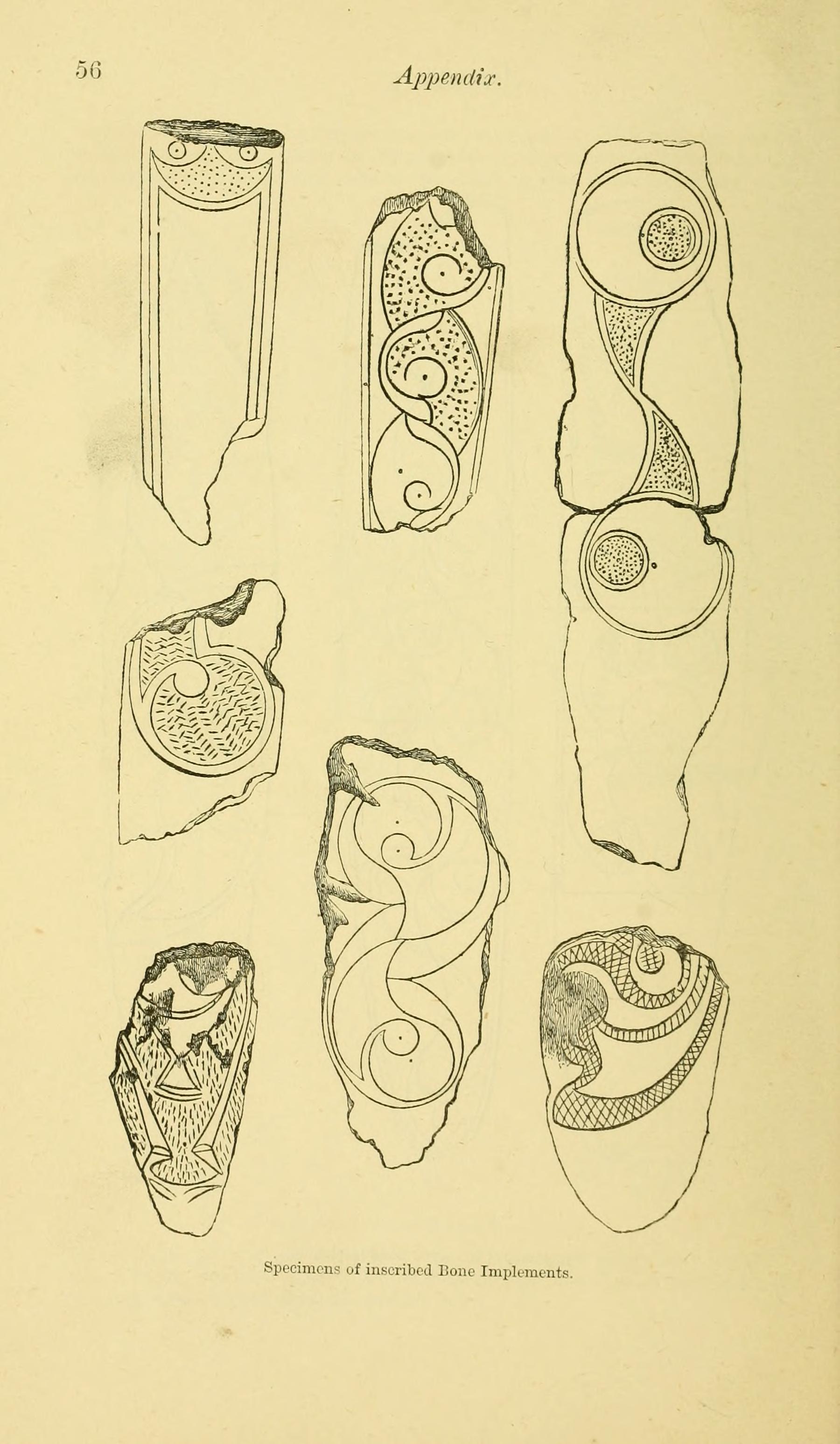
Source term: bone flakes; bone slips
Four thousand eight hundred and eighty-four worked pieces of polished bone came out of a Neolithic cairn on Carnbane West in 1865, and nobody has settled what they are. Radiocarbon on two of the plain slips gives 165-55 BC: Iron Age offerings pressed into the sockets of the chamber's standing stones three thousand years after the tomb was built, and the stones set back on top. Five hundred and one carry rows of fine transverse lines; ninety-one are drawn with a compass, in trumpet curves and engine-turned shading, and one bears a stag, "the only attempt in the collection to depict any living thing". Fourteen are pierced by a single hole near one end. In 1949 H. G. Tempest set them beside "the 'bullroarers' of the Australian (and other) natives" and then put the comparison down, because the pierced ones are so few and their holes show no wear. Nor had he anything better. The combs among them are "quite unsuited for weaving"; the blades "might possibly" have tapped the woof into place; any answer, he admits, must account for "the very large number found together" and for their being "confined to the single group of cairns in these islands". The roarer stays on the table. A minority inside a deposit of five thousand is a class, not a coincidence, and no one has yet weighed one of these blades on a cord.
12 plain fragments perforated for suspension by a single hole near the end; 501 fragments ornamented with rows of fine transverse lines, and two others similarly ornamented, and perforated near the end... In some instances the perforations near the end appear to have been counter sunk.
Eugene Conwell, PRIA 9 (1864-66), pp. 363-364, on the Cairn H bone assemblage
Particulars
- Object
- Polished bone slips: long, narrow, gently curved lenticular blades. Tempest 1949 p. 15 on the material: "probably made from ox bones, some perhaps from the ends of rib bones, but the majority were more probably shaped from the solid parts of the long bones of the legs, for in no other way could a blade be made which showed no cancellous tissue at ends or sides." Conwell says "Many of them resemble in size and shape the flint knives of Scandinavia"; Lucas gives one at 13.5 cm long. Of the 4,884 pieces Conwell saved in 1865, fourteen, twelve plain and two ornamented, are pierced by a single hole near one end, which Tempest describes as "bored from each side, or sometimes apparently sawn". 501 pieces carry rows of fine transverse lines; 91 are engraved by compass, twelve of those on both sides; one carries a cross-hatched antlered stag; one ends in a fish-tail shape; 13 are comb fragments. No thickness figure has ever been published.
- Function
- Not recorded.
Source
Eugene Alfred Conwell, "On Ancient Sepulchral Cairns on the Loughcrew Hills," Proceedings of the Royal Irish Academy 9 (1864-66), pp. 355-379; H. G. Tempest, "Bone Objects from an Irish Burial Cairn," Man 49 (1949), pp. 13-16; Mara Vejby, "Radiocarbon Dates from the Loughcrew Cairn H Bone Slips," Oxford Journal of Archaeology 35(2), 2016, 213-221