MUS2026-199 - museum specimen
Kwaplalim settlement, five miles from Menyamya (people not named; Anga-speaking area)
Papua New Guinea - Morobe Province, Menyamya district - Oceania - Sahul
Function not recorded
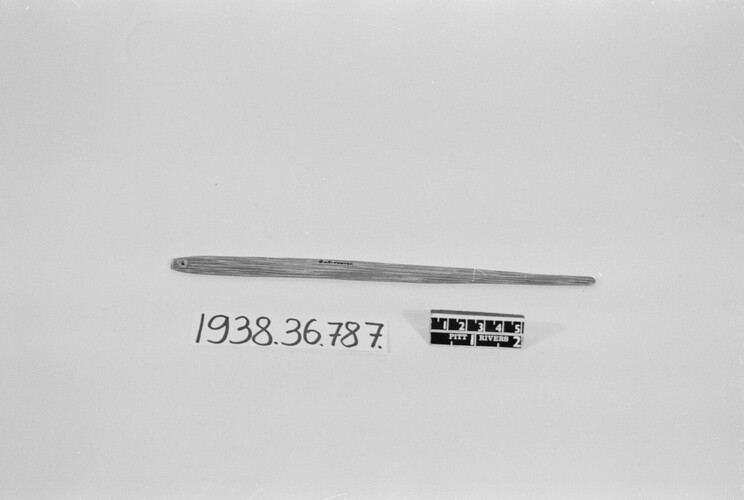
Six slender rods, each about twenty-seven centimetres long and tapering at both ends, came from Kwaplalim, a small settlement five miles from Menyamya in the Anga country of Morobe Province. Every rod is coated in red ochre except one thin bare strip, and each hangs on its own plaited fibre cord, knotted through a hole at the tip; the six cords were then tied together into a single bundle. Linda Manning collected the set in the early 1980s, and Oxford's curator of musical instruments, Hélène La Rue, examined the rods and confirmed them as bullroarers in 2000. Who swung them, and for what, was never recorded — what survives is the bundle itself, six voices tied together.
Hélene la Rue has confirmed [26.7.2000] that these are bullroarers
Pitt Rivers Museum record, 1996.40.1.1-.6
- Object
- PRM 1996.40.1.1-.6 (irn 46072): six slim shaped rods (museum: '?bamboo', identification uncertain), c. 270 x 20 mm, tapering at each end, coated in ochre except a thin bare strip, each with a plaited fibre cord knotted through a terminal perforation — all six cords tied together; collected by Linda Manning 1981-1985/86, donated 1996.
- Function
- Not recorded.
- Map confidence
- medium - Offset from Menyamya township toward the record's 'Kwaplalim (a small settlement five miles from Menyamya)'; exact village not located on modern maps
- Source location
- PRM object record 1996.40.1.1-.6 (irn 46072)