MUS2026-232 - museum specimen
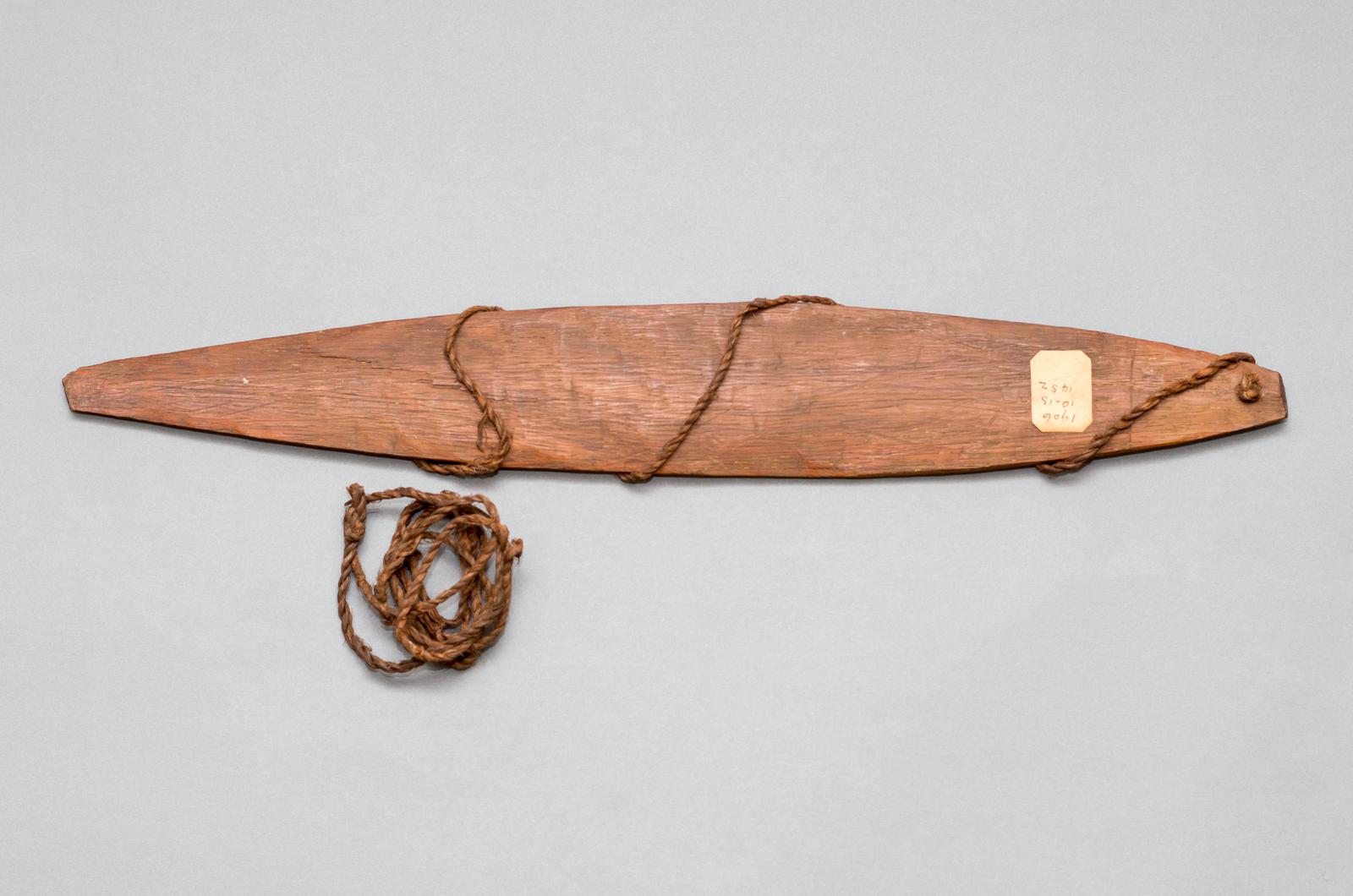
Bensbach bullroarer with intact cord
Papua New Guinea - Western Province (Trans-Fly) - Bensbach River - Oceania - Sahul
Function not recorded
Source term: bullroarer
A blade of palmwood forty centimetres long, ovoid and stained red: a single incised line and a small drilled hole near one end, and on the reverse face several scratched marks, one shaped like the letter K. A length of twisted coconut-fibre cord still runs through the hole, wound around the blade and cut; a second coil survives loose beside it. Major William Cooke Daniels's expedition carried it out of the Bensbach River country in 1903-04, and Charles Seligman gave it to the British Museum in 1906. Of who cut the palmwood, or what the roaring was for, the record says nothing.
Perforation threaded with length of twisted coconut fibre cord, wrapped around bullroarer and severed. Further coil of cord no longer attached.
British Museum collection record, museum number Oc1906,1013.1452, description field
- Object
- An elongated ovoid blade carved from palmwood, 40.3 cm long, 6 cm wide including the cord, 1.2 cm thick, stained red. One face carries a single incised line near the end with a small circular perforation above it; the opposing face carries several incised scratches, one forming a design or the letter K. The perforation is threaded with a length of twisted coconut-fibre cord, wrapped around the blade and severed; a further coil of cord survives detached. An old paper accession tag is tied to the blade in the museum photograph.
- Function
- Not recorded.
- Source
- stained red with single incised line near end on one side and small circular perforation above this; Several incised scratches, one forming design or letter K, on opposing side; Perforation threaded with length of twisted coconut fibre cord, wrapped around bullroarer and severed; Further coil of cord no longer attached." Production ethnic group "Made by:…
- Source location
Page references
British Museum Oc1906,1013.1452 (Daniels Ethnographical Expedition, 1903-04; Seligman donation 1906)
- Source confidence
- medium Bensbach River regional anchor; the record's only place field is the river, with no village or collecting point.