No. FORD1959-001
Birnirk site baleen bull-roarers (Ford 1959)
United States · Piġniq (Birnirk site), near Utqiaġvik, Alaska · North America · Arctic
Play / practical
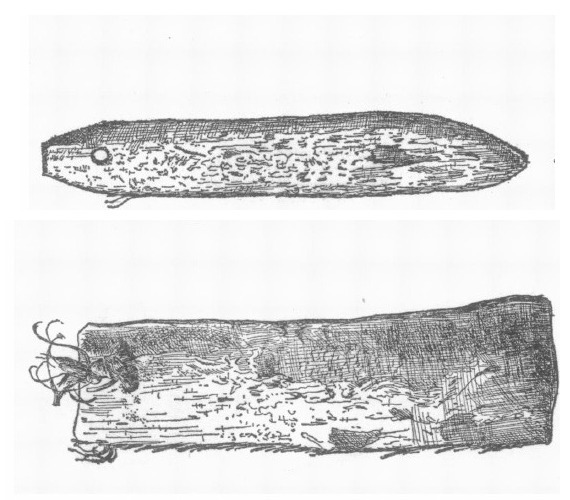
Under the grassy mounds at Piġniq, five kilometres up the Chukchi shore from Utqiaġvik, James Ford's crews cut into the houses of the Birnirk people — the whale-hunting culture ancestral to the Iñupiat — and brought up narrow blades of baleen, each pierced at one end for a baleen string. He filed them with the toys, and noted the bull-roarer as a trait Birnirk handed on to the Thule culture that spread across the entire American Arctic: children spinning whalebone on this beach perhaps a thousand years before the ethnographers arrived to watch their descendants do the same.
Three bull-roarers were found: two from Mound A, Cut 3, Section 4, and one from Mound J, Cut 13, Section 4. All were narrow rectilinear pieces of baleen pierced at one end for a string, also usually made of baleen.
James A. Ford, Eskimo Prehistory in the Vicinity of Point Barrow, Alaska (1959), pp. 227-228
Particulars
- Object
- Three narrow rectilinear baleen blades, each pierced at one end for a string usually also of baleen: two from Mound A, Cut 3, Section 4, one from Mound J, Cut 13, Section 4.
- Function
- Classed by Ford under 'Toys and objects possibly used as toys'; he notes bull-roarers as a trait Birnirk shared with the Thule culture.
Source
James A. Ford, Eskimo Prehistory in the Vicinity of Point Barrow, Alaska (AMNH Anthropological Papers 47.1, 1959), pp. 227-228 and Fig. 112 a-b (caption p. 226)