No. NAAIN-015
Saint Michael ivory-and-hide blade
United States · Alaska · Norton Sound · North America · Arctic
Play / practical
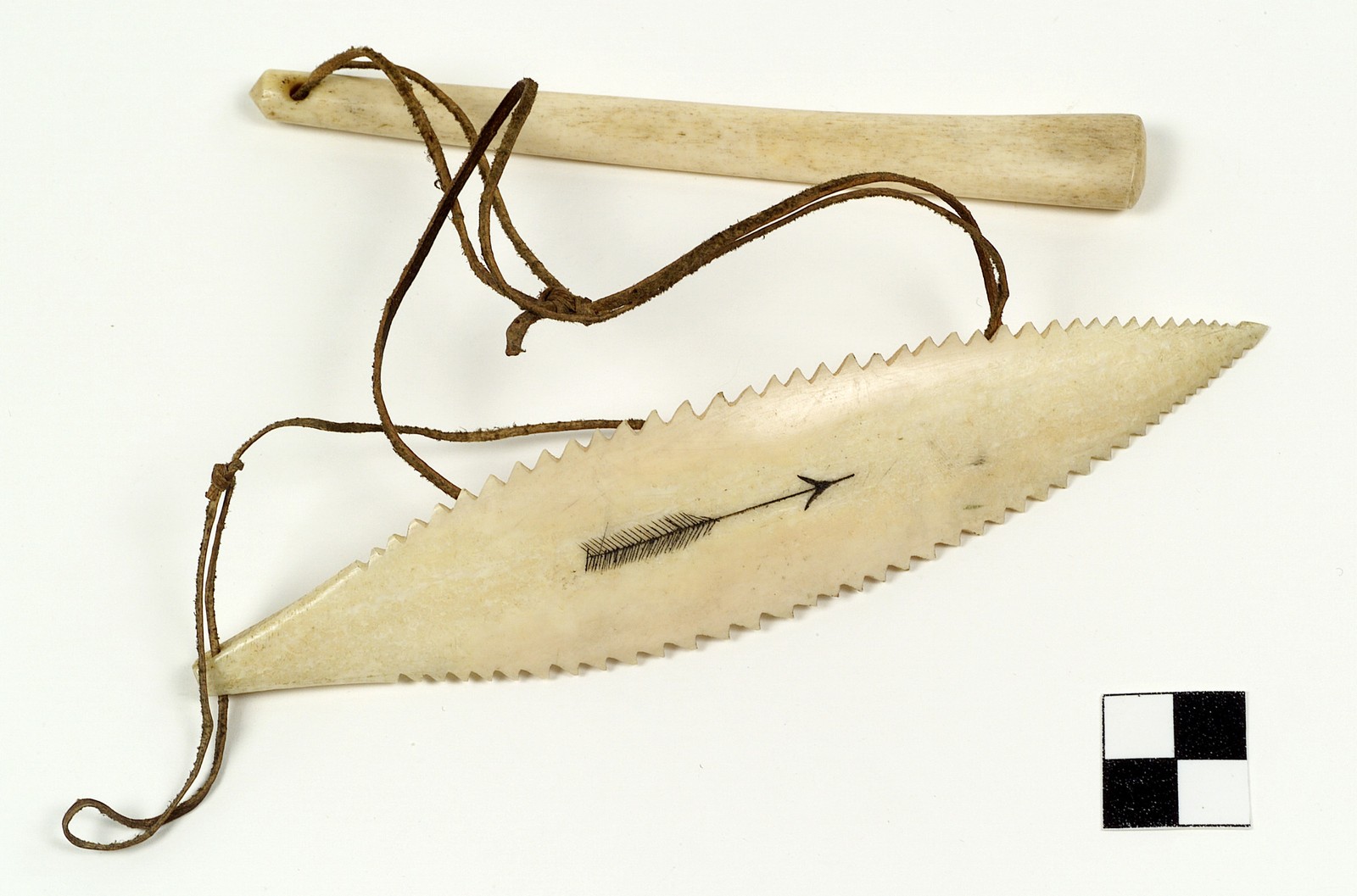
Source term: Bullroarer
A Yup'ik bullroarer of ivory and hide, collected on Saint Michael Island in Norton Sound and dated between 1850 and 1920, now in the National Museum of the American Indian. Its path runs through Alaska: possibly gathered by the prospector-collector Ella Ongman, who worked in the territory between 1901 and 1908, then passed to Dr. Clemens F. Fulda, from whom George Heye bought it in 1912. What this piece was used for went unrecorded. At Saint Michael, Edward William Nelson, collecting for the Smithsonian out of the post, found the local spinning device in children's hands and set it among their games and toys: a "buzz" of wood, ivory, or bone, a doubly perforated flattened disk strung on a cord whose ends are tied into a loop and held in both hands, twirled by tightening and slackening the grip. One he obtained at the post was cut from the adjoining finger bones of an animal, probably a seal, still joined at the cartilage; on that piece the string was a single cord of sinew made fast between the two middle bones, with a short cross-stick at each end for grasping.
Particulars
- Object
- Ivory and hide bullroarer dated 1850-1920
- Function
- Not recorded.
Source
Smithsonian National Museum of the American Indian, 2/9442 (Yup'ik, St. Michael, Alaska)