No. ARCTIC-006
"Devil-Chaser" bullroarer, St. Lawrence Island
United States · St. Lawrence Island, Bering Sea, Alaska Territory · North America · Arctic
Sacred / spirit
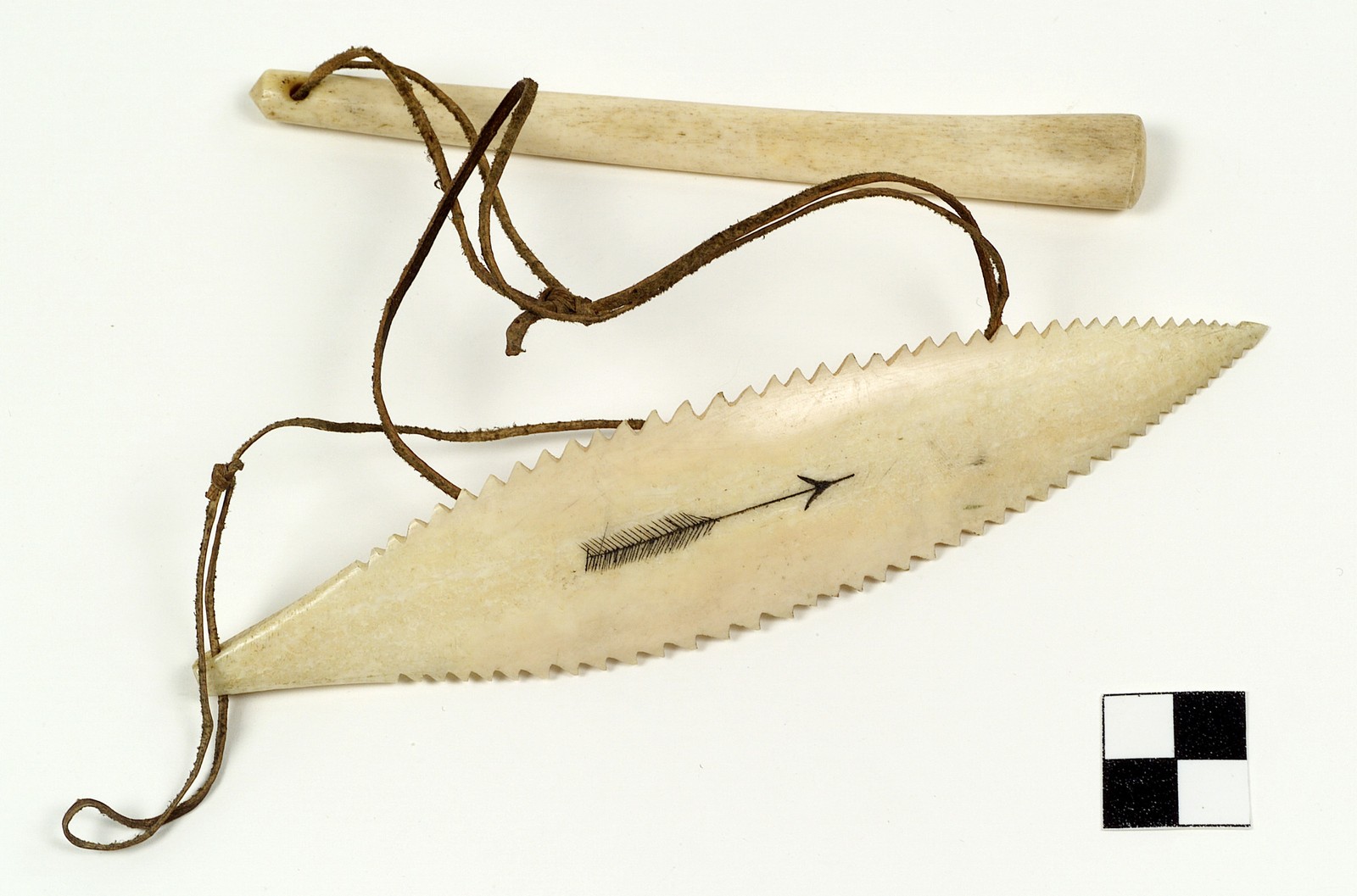
Source term: Devil-Chaser
English museum nickname for the object.
Collected on St. Lawrence Island in the middle of the Bering Sea and accessioned by the Smithsonian in 1913, this Yupik bullroarer is a long, slightly curved wooden rod that, swung on its cord, throws off a low vibrating roar; a small human face is carved into the end of its handle. The museum keeps it under the nickname "Devil-Chaser" and admits it does not know why, noting only that the Inupiaq farther north called such whirled rods 'wolf-scarers.' Its single-rod form sets it apart from the doubled-cord buzz-disk that was the other spinning toy of these islands.
This long, slightly curved wooden rod was swung with a circular motion fast enough that it would emit a loud, low, vibrating noise... The 'Devil Chaser' has a small face carved into the end of the handle.
Smithsonian Arctic Studies Center / National Museum of Natural History, collection feature on the St. Lawrence Island Yupik (Smithsonian Learning Lab), describing the bull-roarer ("Devil-Chaser") collected by R. D. Moore, accessioned 19 October 1913.
Particulars
- Object
- A bullroarer collected on St. Lawrence Island in the Bering Sea: a long, slightly curved wooden rod, swung in a circle on a cord fast enough to emit a loud, low, vibrating roar, with a small human face carved into the end of the handle. Held by the Smithsonian National Museum of Natural History (Department of Anthropology), collected by Riley D. Moore and accessioned 19 October 1913. The Smithsonian catalogues the object as a bull-roarer; its museum nickname is "Devil-Chaser."
- Function
- Function not recorded for this specimen; the Smithsonian states the reason for the name "Devil-Chaser" is uncertain. Bullroarers of the region (the Inupiaq call them 'wolf-scarers') were used as predator- and spirit-driving noisemakers, but no specific ritual use is documented for this object.
Sources
- Smithsonian Arctic Studies Center, “The St. Lawrence Island Yupik People and Their Culture,” Smithsonian Learning Lab, “Devil-Chaser” bull-roarer, NMNH E280159-0 View · archived
- Smithsonian National Museum of Natural History, bull-roarer E280159-0 View
- Murdoch, “Ethnological Results of the Point Barrow Expedition,” Ninth Annual Report of the Bureau of Ethnology (1892), pp. 377–379
- Nelson (1899), pp. 340–342
- Peter Whitridge, “The Sound of Contact: Historic Inuit Music-Making in Northern Labrador,” North Atlantic Archaeology 4 (2015), pp. 19–20