No. TUCCI1969-001
Upper Illasi valley surla a man
Veneto · Lessinia · Europe · Northeast Italy
Play / practical
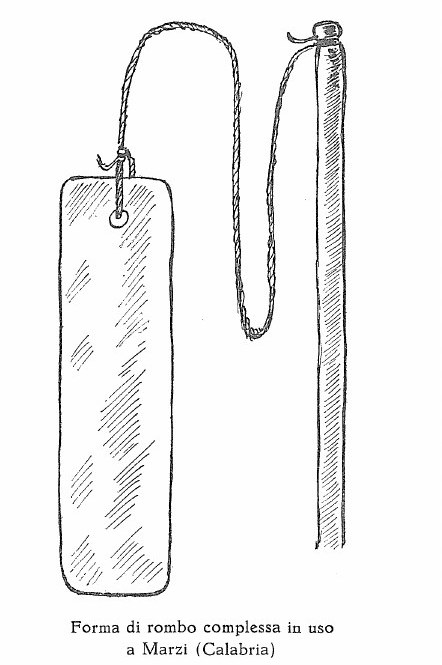
surla a man
surla — Veronese for the chafer beetles and their buzz; a man 'by hand', a brasso 'by arm'.
In the mountain country at the head of the Illasi valley above Verona, the bullroarer took its name from an insect: surla, the local word for the chafer beetles whose midsummer drone it matched. Boys knew two forms — the plain surla a man, a slat whirled from the hand, and the more elaborate surla a brasso worked from the whole arm — and when Giovanni Tucci came asking in the 1960s, a valley correspondent could still send him the instruments themselves.
Il rombo in tali contrade viene chiamato «surla», termine col quale i veronesi denominano le cetonie e i maggiolini, e pertanto la denominazione si collega al caratteristico rumore che questi insetti producono volando.
In these districts the rombo is called 'surla', the word by which the Veronese name the rose-chafers and cockchafers, and so the name is tied to the characteristic noise these insects make in flight.
Giovanni Tucci, 'Studi e ricerche sul rombo in Italia', Rivista di Etnografia XXIII (1969), p. 366
Particulars
- Object
- Wooden slat bullroarer whirled from the hand; a more elaborate arm-worked form, the surla a brasso, was used beside it.
Source
Giovanni Tucci, 'Studi e ricerche sul rombo in Italia,' Rivista di Etnografia XXIII (1969), pp. 363-377