No. EUROPE-011
Venice el motor bullroarer
Venice · Cannaregio · Europe · Northeast Italy
Play / practical
el motor
Source term: rombo / el motor
el motor — Venetian boys' name, from their word for the aeroplane/propeller; rombo is the standard Italian name for the bullroarer.
Etymology. Italian rombo continues the classical term for a spinning, whirring noise.
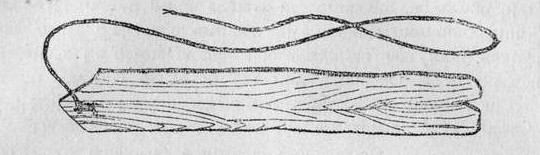
One evening late in August 1921, as his gondola drew away from the Fondamente Nuove toward Murano, Raffaello Battaglia heard a deep hum rise from the bank, climbing fast — and knew it at once for the rombo. He turned and saw a small boy whirling the blade. The next day he went looking, and in the dark corner of a kitchen off the Calle delle Tre Croci he found it: a rough softwood tablet half a metre long, its cord fixed to a nail, its top cut to a triangle. The boys of Venice called it el motor — their word for the aeroplane propeller — the oldest instrument in the lagoon wearing the newest name in the sky.
Udii partire dalla riva un ronzio cupo che andava rapidamente crescendo in altezza. Il mio pensiero corse subito al rombo.
I heard a deep hum rise from the bank, rapidly growing higher. My thoughts ran at once to the rombo.
Battaglia 1925:192
Particulars
- Object
- Rough softwood tablet about 50 x 10 x 0.5 cm, the top cut to a triangle, the base rounded with a central triangular notch; the single whirling cord was fixed to a nail driven into the upper end. Battaglia's Figure 1 shows the recovered object.
- Function
- A boys' toy: Battaglia heard it whirled at dusk from the Fondamente Nuove in August 1921 and recovered the blade the next day. The comparative literature treats such Italian rombi as folk survivals of a once-sacred instrument.
Source
Raffaello Battaglia, 'Sopravvivenze del rombo nelle Provincie Venete,' Studi e Materiali di Storia delle Religioni 1 (1925), pp. 190-217, at pp. 192-193 and fig. 1; Raffaele Pettazzoni, 'Rombo,' Enciclopedia Italiana (1936)