No. BATTAGLIA1925-004
Trieste la striga bullroarer
Trieste · Rozzol-Settefontane · Europe · Northeast Italy
Play / practical
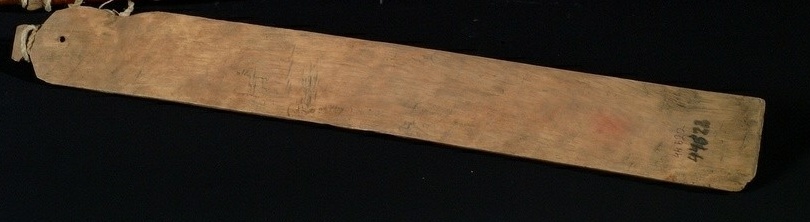
la striga
Source term: la striga; the game 'far el vento'
la striga — Triestine 'the witch' (strega); the game was far el vento, 'to make the wind'.
In Trieste the bullroarer was cut from the lightest wood to hand — the slats of orange crates — thirty to sixty centimetres long, a hole at one end, whirled at a run through the summer streets. Sixty years before Battaglia wrote, the children of Rozzol-Settefontane called its dark voice la striga, the witch, and shouted to each other to hear her screech. Other Trieste boys named the game itself: far el vento, making the wind.
'Senti come che ziga la striga', esclamavano i monelli udendo la voce cupa e impressionante del rombo.
'Hear how the witch screeches!' the urchins cried on hearing the deep, unsettling voice of the bullroarer.
Battaglia 1925:200
Particulars
- Object
- Rectangular or elongated-oval slat, 30-60 cm, cut from the light wood of orange crates, a hole at one end for the whirling cord. On the colle di San Vito, boys whirled a flat stone on a string the same way — Battaglia's 'new and uncommon type of rombo' in which a stone replaces the usual wooden slat.
- Function
- Boys' summer toy, whirled at a run through the streets; its deep voice earned it the district name la striga, 'the witch', and the game itself was called far el vento, 'making the wind'.
Source
Raffaello Battaglia, Sopravvivenze del rombo nelle Provincie Venete (1925), pp. 197-201: orange-crate slats 30-60 cm whirled in summer (p. 197); 'la striga' naming at Rozzol-Settefontane ~1865, informant E. Neumann (p. 200); 'far el vento' from Dr. P. Calleari and don Novack (p. 201)