No. ZERRIES1964-001
Waika alabaco, Mahekodotedi
Venezuela · Upper Orinoco · Mahekodotedi (El Platanal) · South America
Play / practical
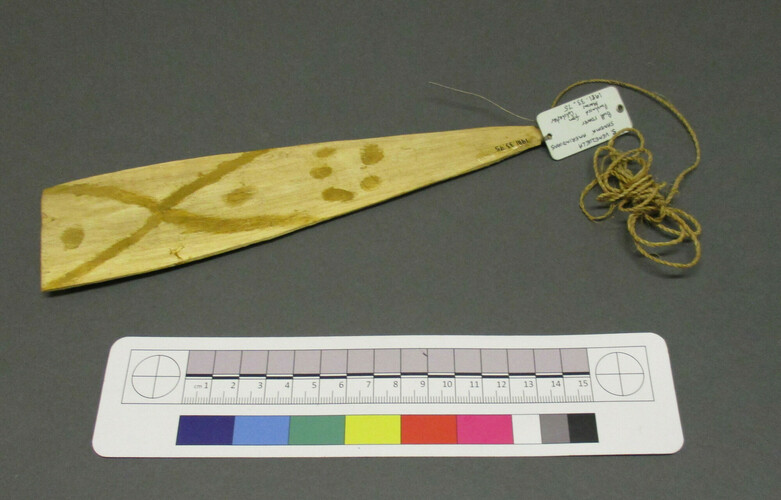
alabaco
Source term: Schwirrholz
alabaco = the Waika name for the Mahekodotedi bullroarer.
At Mahekodotedi in 1954–55, children whirled the alabaco: an oval blade a forearm long, painted with geometric designs in onoto, the red annatto pigment, its cord tied through a hole or to a little peg. Otto Zerries called it an uncommon toy. In his account the Waika, now generally called Yanomami, otherwise had no musical instruments; where the bullroarer belonged to boys’ initiation among many other peoples, here it belonged to play. He knew of no report from another Yanomami group at the time.
kennen die Waika — in diesem Falle ein echtes Randvolk — keinerlei Musik-Instrumente, jedoch ist bei den Leuten von Mahekodo-tedi das Schwirrholz, „alabaco“ mit Namen, ein nicht sehr häufiges Spielzeug
The Waika know no musical instruments whatsoever; yet among the people of Mahekodotedi there is the bullroarer, alabaco by name, a not very common toy.
Otto Zerries, Waika (1964), p. 202.
Particulars
- Object
- Elongated-oval wooden blade, 32 by 4 cm, painted with simple geometric designs in onoto; the whirling cord is fixed either through a perforation or to a small peg.
- Function
- A children’s toy, and an uncommon one. Zerries records that among the Waika the bullroarer had sunk wholly into the profane, against its initiation role among many other peoples.
Source
Otto Zerries, Waika: Die kulturgeschichtliche Stellung der Waika-Indianer des oberen Orinoco im Rahmen der Völkerkunde Südamerikas (Munich: Klaus Renner, 1964), p. 202