No. MUS2026-029
Rung rung's evening circuit against sorcerers
El Salvador · Nahuizalco, Sonsonate · Mesoamerica · Central America
Sacred / spirit
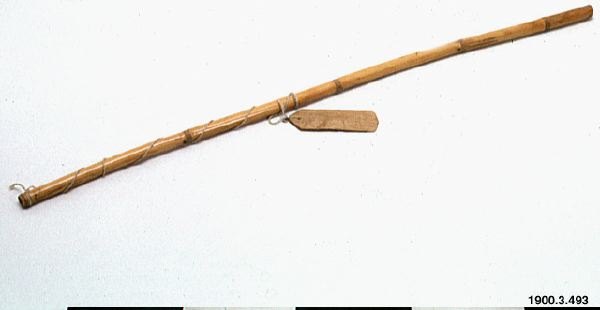
rung rung
Source term: bull-roarer
rung rung: Nawat/Pipil name for the bullroarer, echoing its sound.
Among the Pipil of Nahuizalco, in southwestern El Salvador, a householder would step outside in the evening and walk three times around his house, swinging a bull-roarer, to drive off evil spirits and sorcerers. This instrument was collected among the Pipil — whom he called "the Aztecs of El Salvador" — by the Swedish ethnographer Carl Vilhelm Hartman, who made Nahuizalco his base during his Central American fieldwork of the late 1890s; his own field note records the apotropaic circuit directly. Three of Hartman's specimens survive together, preserving the local name rung rung: a slat corded at one end to a long reed handle.
Denna vinare användes för att skrämma bort onda andar och häxkarlar. Ägaren till huset går på kvällen tre varv omkring detta svängande sin vinare. Hartman anteckningar.
This bull-roarer was used to scare away evil spirits and sorcerers. The owner of the house walks three times around the house in the evening, swinging his bull-roarer. Hartman's notes.
Carl Vilhelm Hartman, field note, Museum of Ethnography (SMVK), Stockholm
Particulars
- Object
- Three Pipil rung rung from Nahuizalco (SMVK 1900.03.0493-.0495): each has a terminal-holed sounding slat on a single cord and long reed handle.
- Function
- Swung in the evening as the householder circled his home three times, to scare away evil spirits and sorcerers.
Source
Museum of Ethnography (SMVK), Stockholm, 1900.03.0493-0495 (objects 1019244-1019246)