No. MUS2026-019
Waiwai roarer of two turtle shells
Guyana · Essequibo headwaters · South America · Guianas
Function not recorded
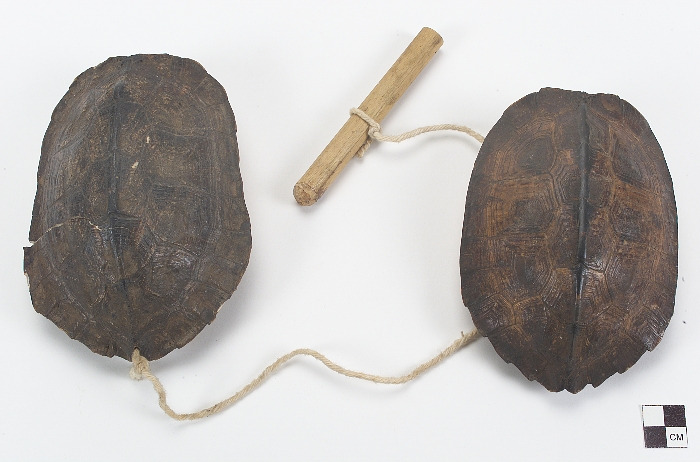
Source term: bull-roarer
Two whole turtle carapaces strung along a plant-fibre cord, a short reed lashed between them — the old museum card says simply 'BullRoarer of Two Turtle Shells. Waiwoi. British Guiana.' The explorer A. Hyatt Verrill collected it among the Waiwai, a Carib-speaking forest people of the Essequibo headwaters, and sold it to the Museum of the American Indian in 1918. When Danish ethnographers documented the Waiwai in depth in 1954-55, they met no bullroarer at all; these two shells remain the instrument's only Waiwai witness.
Particulars
- Object
- Bullroarer of two turtle carapaces joined by a plant-fibre cord to a short reed, NMAI 7/4485; collected in British Guiana by A. Hyatt Verrill and purchased by the Museum of the American Indian in 1918.
- Function
- Not recorded for the turtle-shell rig.
Source
Smithsonian National Museum of the American Indian, 7/4485 (collected by A. Hyatt Verrill; purchased 1918)