No. HARDING1973-003
Pin Hole Cave's mistaken bull-roarer
United Kingdom · Creswell Crags · Derbyshire · Europe · British Isles
Function not recorded Candidate only
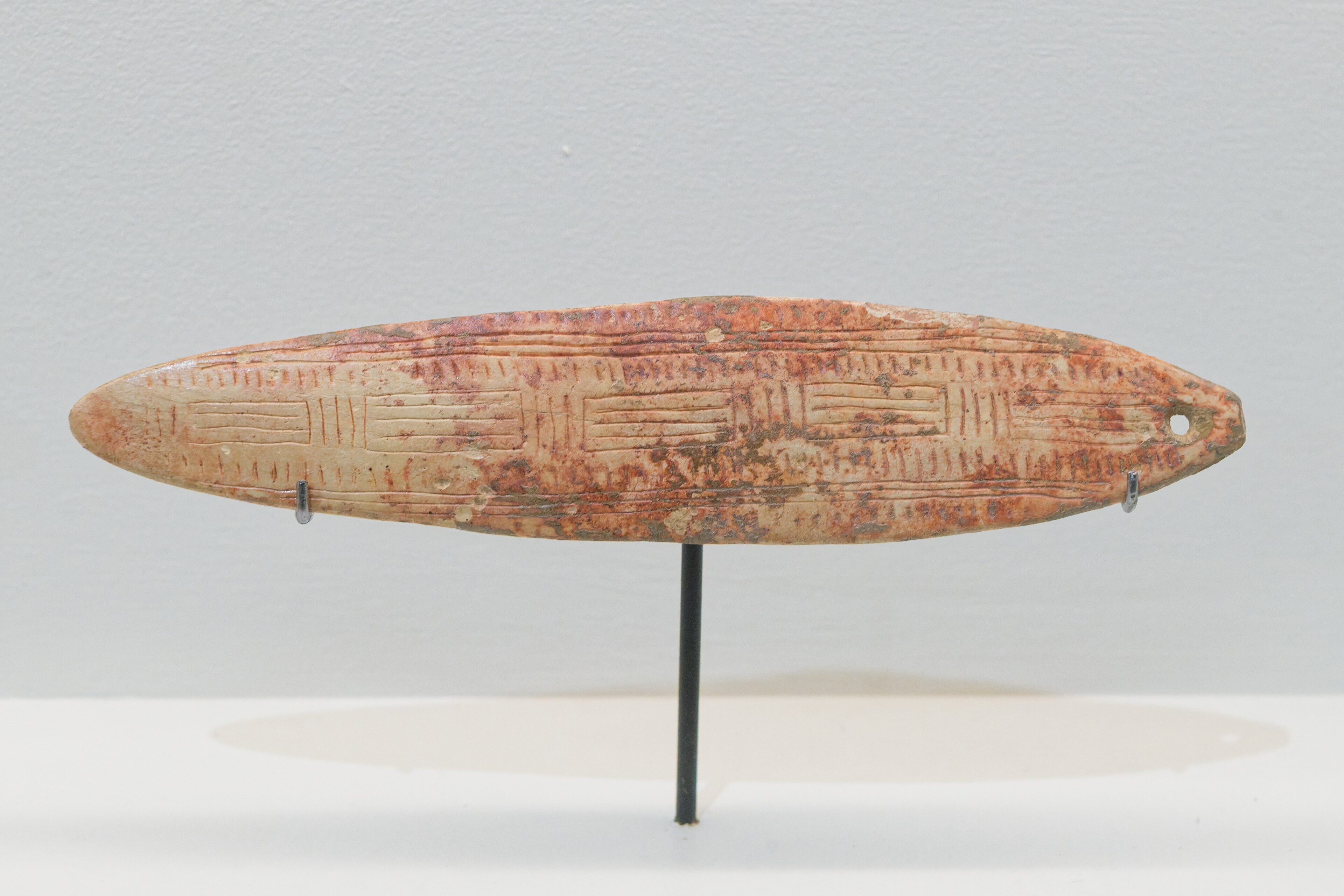
Source term: bull-roarer pendant
When James Harding surveyed the bull-roarer's deep antiquity in 1973, he pointed to Pin Hole Cave at Creswell Crags in Derbyshire as a European, possibly Gravettian instance — bone objects he read as pendants imitating the blade of the instrument, found among "Mousterian-type implements which survived into the Gravettian at the beginning of the Upper Palaeolithic period." The claim traces back to A. L. Armstrong, who excavated the cave through the 1920s and 1930s and in 1936 published a perforated rib under the title "A Bull Roarer of Le Moustier Age from Pin Hole Cave, Creswell Crags," arguing the hole had held a thong so the bone could be whirled to make a sound. Later analysis dismantled the identification: the piece is an eroded bison rib, one of a number of such fragments from the deposits now understood to be partially digested bone regurgitated by hyaena. No worked wooden prototype was ever recovered, and Harding himself conceded the supposed wooden originals had not been preserved.
Eroded bone fragments can lead to erroneous conclusions such as Armstrong's description of an eroded bison rib as a 'bull-roarer'.
Derbyshire Historic Environment Record, MDR6578 (Pin Hole Cave)
Particulars
- Object
- A perforated, eroded bison rib.
Sources
- Harding, The Bull-roarer in History and in Antiquity, African Music 5(3) (1973):40–42, p. 41; citing Sollas (1915) and E. O. James (1957) View · archived
- A. L. Armstrong, “A Bull-Roarer of Le Moustier Age from Pin Hole Cave, Creswell Crags, Derbyshire,” The Antiquaries Journal 16(3) (1936):322–323
- Derbyshire Historic Environment Record, MDR6578, Pin Hole Cave; reporting Kitching’s re-analysis
- Iain Morley, The Evolutionary Origins and Archaeology of Music, Darwin College Research Report DCRR-002 (Cambridge, 2003), §3.1