No. MUS2026-178
Ickleton Cambridgeshire Buzzer bullroarer
United Kingdom · Cambridgeshire · Ickleton · Europe
Play / practical
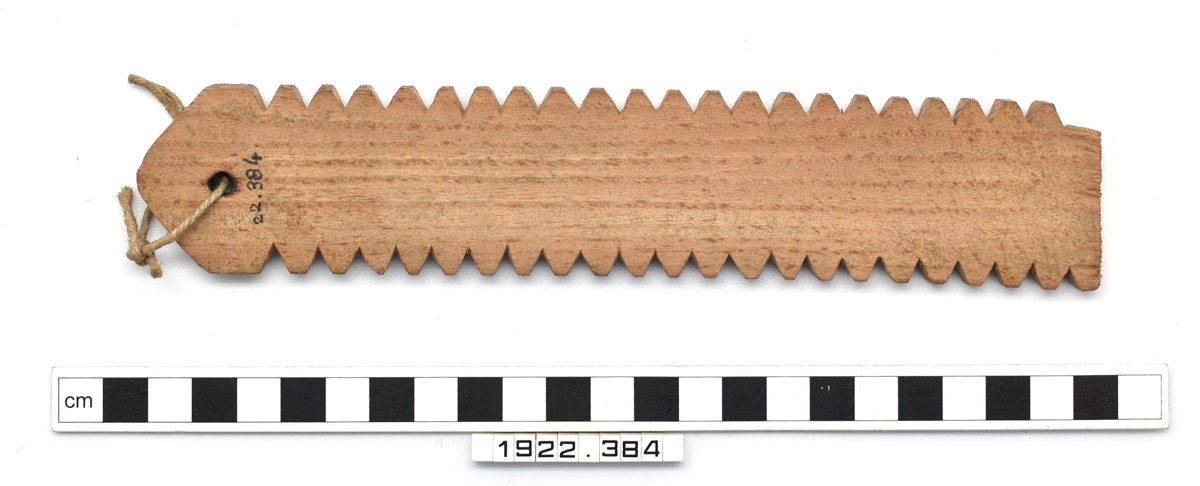
Buzzer
Source term: Bullroarer
Buzzer: the local name inked on the board, after the noise it makes when whirled.
A thick, pointed board lined with small sawteeth along both edges, its cord still knotted through a hole at one end, was collected at Ickleton in Cambridgeshire and marked in ink with its local name: 'Buzzer.' That name cuts against what Alfred Haddon heard elsewhere in the same county, where the same whirled toy was simply a 'bull' and its edges were left plain. One county, two names, two finishes.
'Buzzer'. Ickleton. Cambs.
MAA 1922.384, handwritten ink marking (Museum of Archaeology and Anthropology, Cambridge)
Particulars
- Object
- Thick, sub-rectangular wooden board, 217 x 42 x 9 mm, with triangular serrations along both long edges; a knotted cord passes through a hole at the pointed end, the opposite end flat.
- Function
- Boys' toy — Haddon's Cambridgeshire informants knew the instrument as the 'bull'; this Ickleton blade, ink-labelled Buzzer, is the same schoolboy toy under a neighbouring name.
Source
Museum of Archaeology and Anthropology, Cambridge (MAA) 1922.384; collected and donated 1922 by Dr A. C. Haddon