No. HAD1898-020
Patani Malay elephant-scarer bullroarer
Malaysia · Thailand · Kuala Langat District, Selangor (Federated Malay States, British Malaya) · Southeast Asia · Malay Peninsula
Play / practical
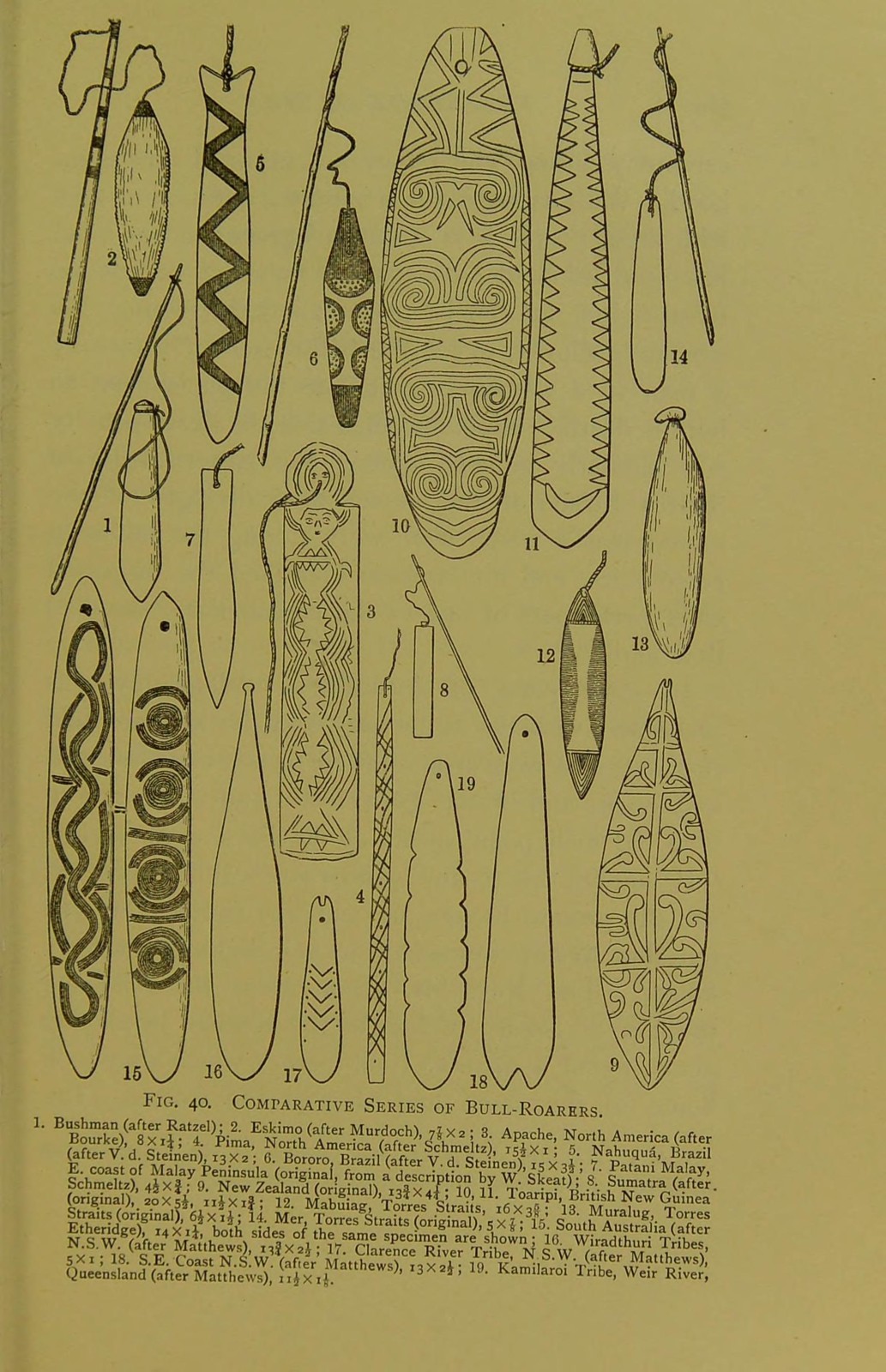
lembing buluh
Source term: lembing buluh / bamboo spear
lembing buluh — Malay for "bamboo spear," the name the Patani boatman gave the two bull-roarers Skeat collected from him; in full, lembing buluh menghalau gajah, "bamboo spear for driving away elephants."
Etymology. Malay lembing, "spear," and buluh, "bamboo."
In the Kuala Langat district of Selangor, W. Skeat of the Federated Malay States Service collected a pair of bull-roarers from a Patani boatman, who called them lembing buluh, "bamboo spear." Swung on their cords, they were used to scare elephants away from the plantations, and one informant told Skeat they "make a noise like a tiger." Haddon, publishing the report in 1898, treated it as the first record of the bull-roarer anywhere on the mainland of Asia, and noted that frightening animals with the sound paralleled the way the Bushmen of South Africa and boys in Galicia and Scotland used the same instrument.
The bull-roarers (Fig. 40, No. 7) are used for scaring elephants away from the plantations. One informant said "they make a noise like a tiger." This is the first record of the occurrence of the bull-roarer on the mainland of Asia.
Haddon, The Study of Man (1898), ch. X "The Bull-Roarer," pp. 298-299
Particulars
- Function
- Bullroarers used to scare elephants from plantations; described as sounding like a tiger.
Source
Haddon 1898, The Study of Man, Chapter X: The Bull-Roarer