Atlas Essay —
A Hole Is Not a Roar
Perm Cis-Urals · Mazovia · Torres Strait
A flat, decorated blade with a hole near one end makes the mind hear a bullroarer before the hand has even picked it up. That is exactly why it is dangerous. The hole may take a cord; it may also hang a tool at the belt. The blade may turn in air; it may part birch-bark strips, carry a tiny ear spoon, or take the bright rubbed streak of a silver alloy. An excavated object does not surrender its voice to a silhouette.
In brief
- Two decorated bone pieces from the medieval Perm Cis-Urals look ready for a cord, but holes and ornament like theirs were ordinary in a local family of weaving tools.
- Nearby-looking objects can betray themselves at a glance: an ear pick has a scoop; a comb has teeth.
- A touchstone is the hard case: chemical traces of silver, gold-bearing alloy, copper, lead, and tin show what its dark face actually did.
- A true bullroarer needs more than a hole. It needs a viable cord attachment and blade, and evidence that no better function explains the object.
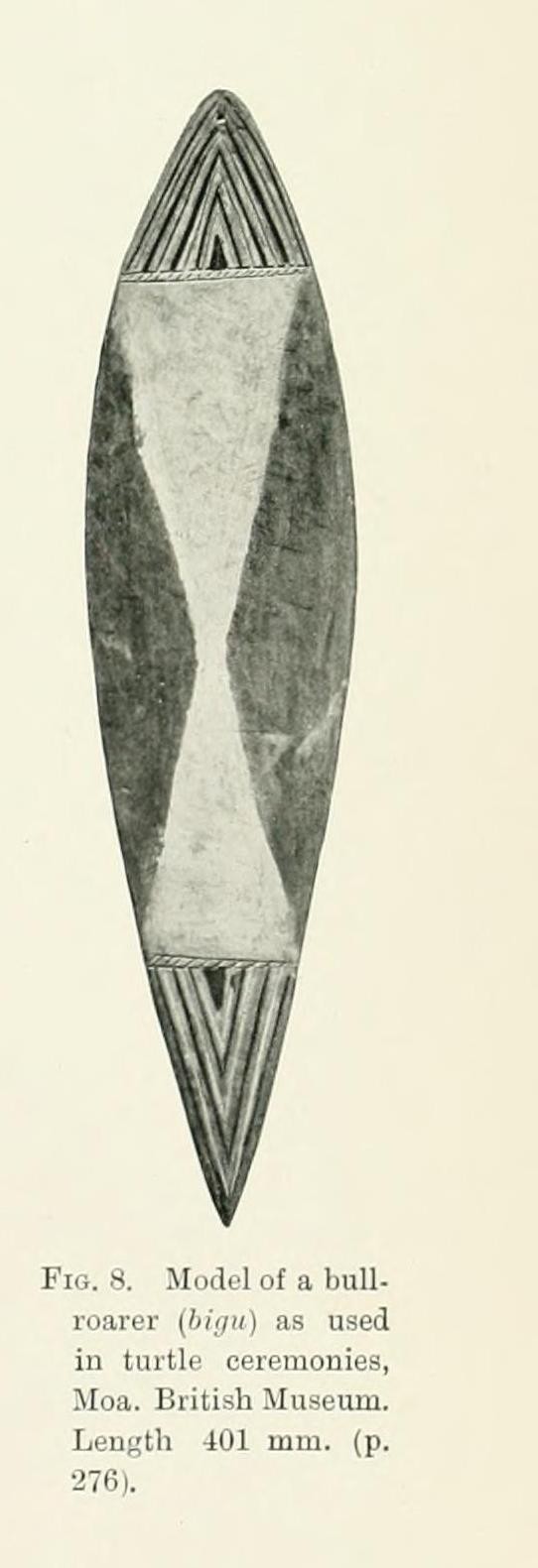
A bullroarer is not a decorated slat with a hole. It is a particular arrangement of cord, blade, air, and motion; archaeology has to recover enough of that arrangement to beat its rivals. The strongest identifications make the object speak. The weak ones merely make it resemble something that could.
The question mark: Perm’s pierced bone blades
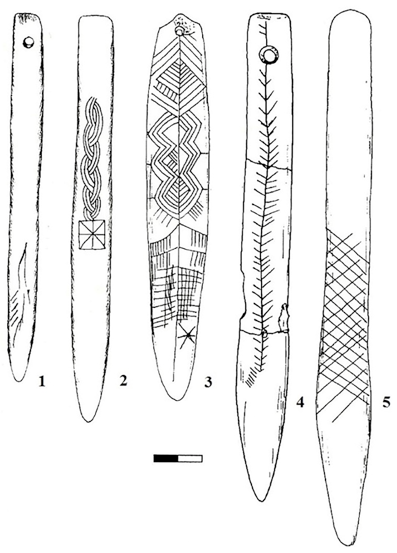
Here is the tempting case. At medieval sites in the Perm Cis-Urals, bone workers made long, decorated pieces with a hole or a knob at the upper end. A 2017 synthesis calls them weaving tools: implements for birch bark, bast, leather, wicker, and heavy thread. Its illustrations carry the very grammar that makes a bullroarer hunter stop cold—slender paddle, terminal perforation, carefully ranked chevrons, lozenges, and a herringbone spine.
Two deserve to stay in the mind. Figure 1 no. 3 is broad and balanced enough to look like a little blade; the roundel at its upper end is probably a small perforation. No. 4 has a larger hole and a central branching design so controlled that it can look, at first glance, like an X-ray of a spine. It is not silly to ask whether either could sound. A bone plate of that size can be whirled. It would be silly to announce the sound before the object has been tested.
The counterweight is substantial but not final. A later Telyachiy Brod study classifies seventeen bone finds or fragments as kochedyki, notes geometric decoration on two, and says five had hanging holes. In other words: the very features that wake the bullroarer hunch were ordinary in a local family of portable craft tools. The two blades remain good questions with sharp edges.
The scoop: an object for the body
The same Perm publication makes the trap plain. Its next plate contains eight long, punctured, patterned things that could be mistaken for small roarers in a drawer or a thumbnail. They are ear picks. Their job is brutally intimate: a small spoon at the lower end lifts earwax. The hole at the other end lets the owner suspend the implement from a cord or belt.
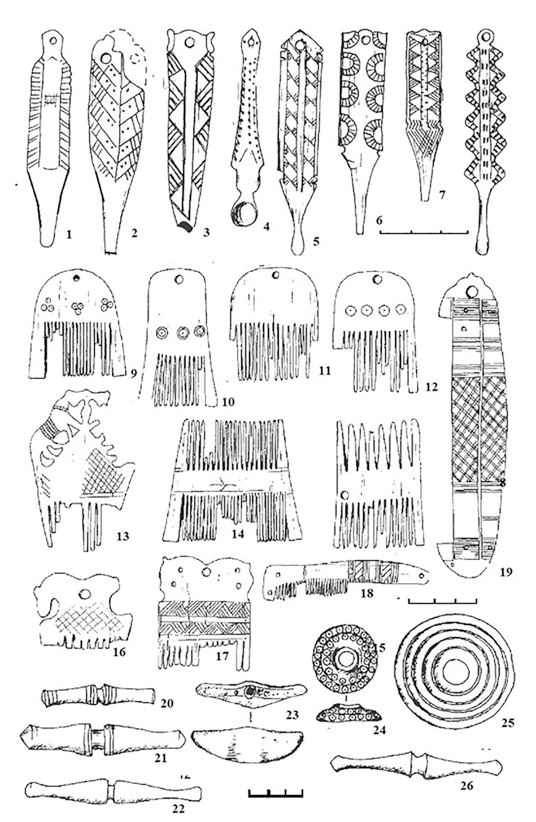
That little scoop changes everything. It is not an accidental nick, and it is not decoration. It is a working end designed for a body. The objects were personal toilet articles and, in the same regional tradition, could carry amuletic force as well. A beautiful thing can be a private tool; a suspended thing need not be a sounding thing. Once the scoop is seen, the roaring hypothesis is over.
The streak: a black stone that knows gold
The most persuasive false friend is unmasked without an argument from shape at all. Early medieval graves in northern and eastern Europe often contain dark, fine-grained stones: oblong, hand-worked, commonly perforated at one end, hung as personal possessions. For generations they were filed away as whetstones. They can look uncannily like a stone bullroarer caught before its cord was tied.
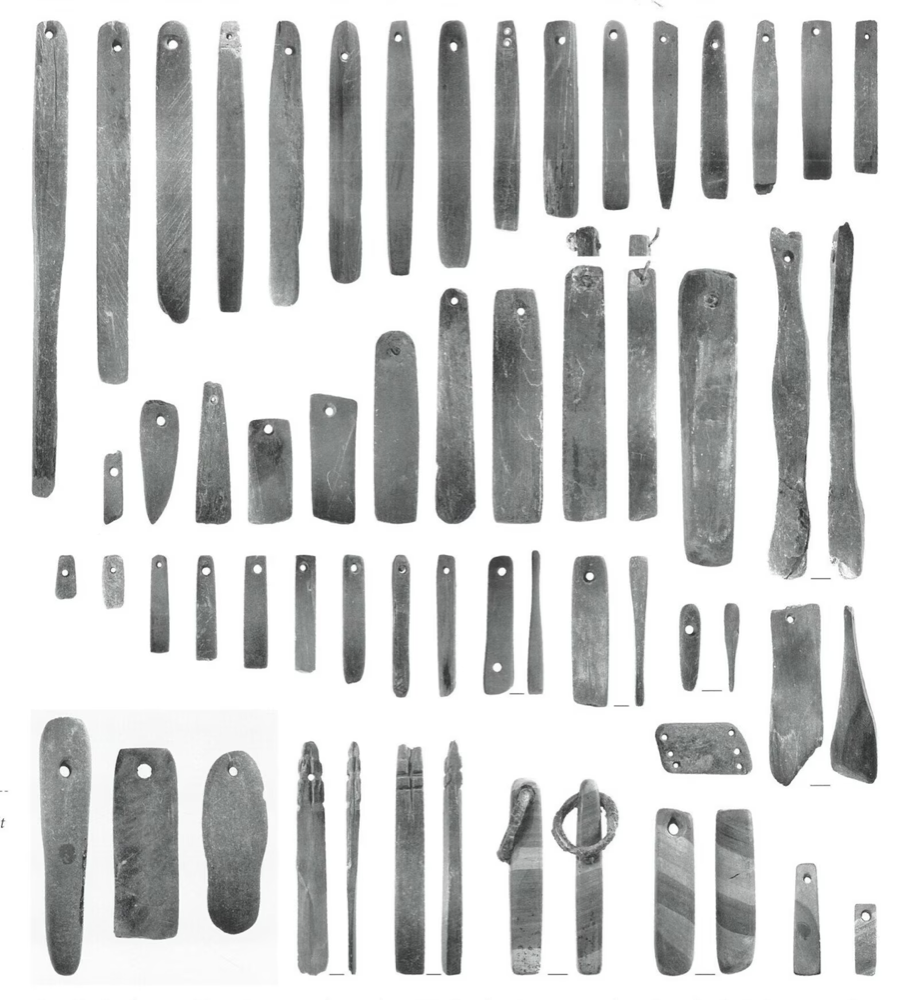
Then the microscope entered the story. Martin Ježek’s analysis of the Pokrzywnica Wielka cemetery in Mazovia found metallic residues on the tested stones: silver; gold-bearing gold-copper-silver alloy; copper; lead; tin. These were touchstones. A trader or metalworker rubbed an unknown metal across the dark surface and compared its coloured mark against known standards. The black blade had not sung in the air. It had judged wealth in a streak of metal.
This is the kind of evidence an outline cannot give. A string hole may be shared. A narrow plate may be shared. Even a polished face may be shared. But chemistry records an action. On the analysed pieces, it records assay.
Three gates for a pierced blade
There is no magic checklist, but a good identification asks the object to clear more than one gate. First comes the whole form: not merely a hole, but a cord attachment placed where a spinning blade can hold it, and a thin enough, balanced enough body to move through air. Then comes the rival: a scoop, tooth row, abrasive face, loom fitting, or other working feature that explains the form better. Finally comes the evidence that belongs to this object—cord wear, a secure contemporary description, diagnostic residues, a replica whose design and acoustic behaviour match, or a find context that makes the proposed use hard to avoid.
The Perm pieces are worth following because they pass the first gate unusually well. The ear picks fail at the second. The touchstones fail at the third, conclusively. That is not a disappointment. It is how an excavated world becomes more crowded and more interesting: not every thin, pierced blade is a roarer, because people found so many other ingenious things for a hole, a cord, a sharp edge, and a beautiful surface to do.
Sources
N. Krylasova, A. Belavin & Y. Podosenova, “Bone carving in Perm Cis-Ural Region in the Middle Ages,” Revista ESPACIOS 38(49), 2017: Figure 1 and its description; Figure 8 and its description.
M. E. Shmyrina, “Bone artefacts of the Telyachiy Brod settlement,” Newest Materials of Archaeological Research, 2023, printed pp. 133–134.
Martin Ježek, “Touchstones of archaeology,” Journal of Anthropological Archaeology 32(4), 2013: 713–731, especially Figure 8 and Table 4.
A. C. Haddon (ed.), Reports of the Cambridge Anthropological Expedition to Torres Straits, vol. IV, 1912, fig. 8.