No. NAGA-008
Tangkhul Naga
Myanmar · Somra Tract, Naga Hills · Southeast Asia · Mainland
Sacred / spirit
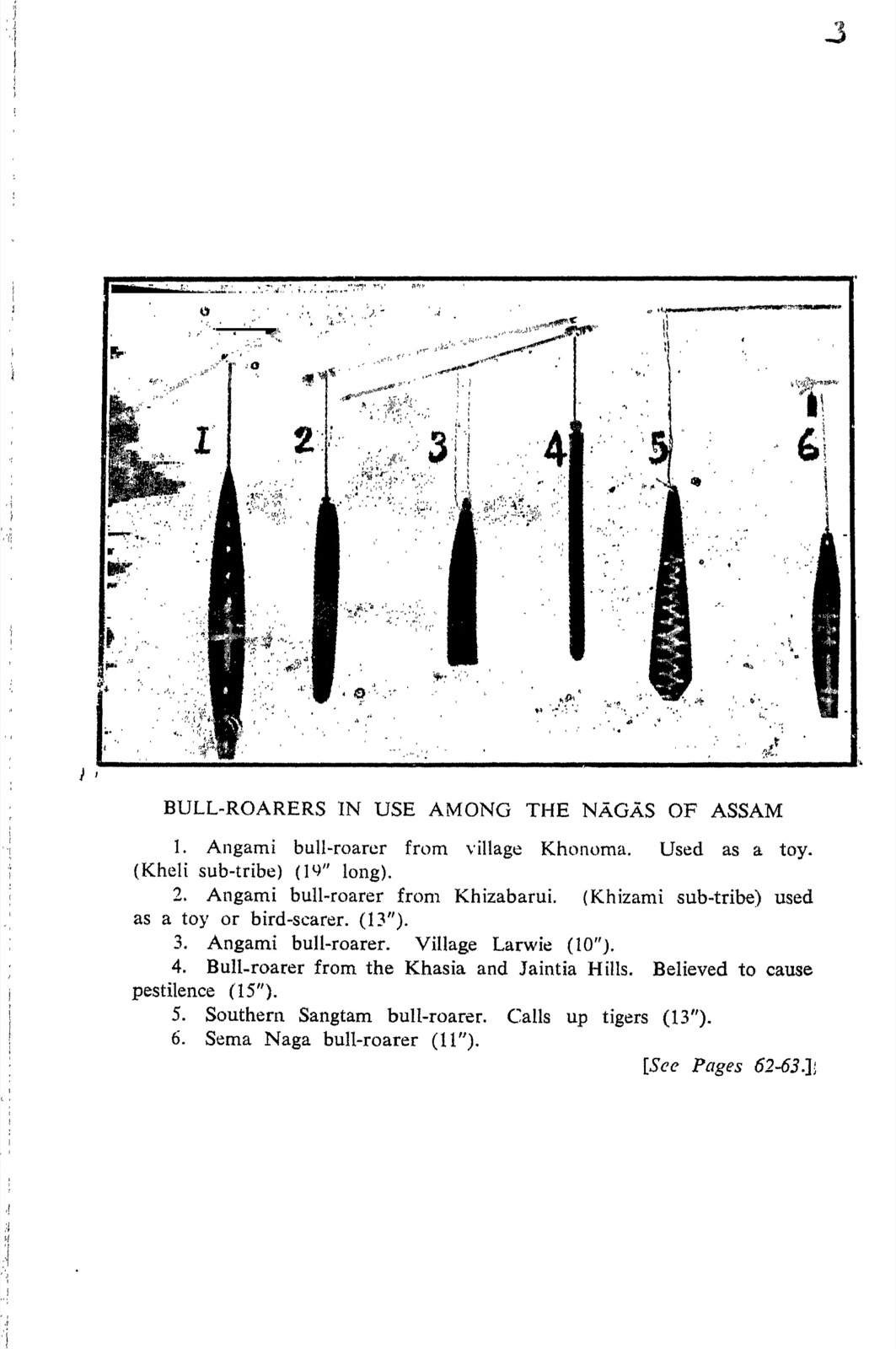
Among the Tangkhul Naga, a death far from home did not have to remain there. The missionary William Pettigrew recorded that when a person died where the body could not be carried back, the skull was brought to the village, and "in place of the trunk left behind a piece of wood, generally the wooden pillow of the deceased, is attached to the skull," wrapped in cloth "to represent the whole person." A board in the Pitt Rivers Museum keeps that logic close: it carries two children's skulls, each ornamented with a wooden blade, and a fringe of twelve bull-roarers. J. C. Higgins brought it from Somra Khulen, an eastern Tangkhul village on the Burmese side of the Manipur border, and gave it to the museum in 1934.
The board carrying heads, with row of bull-roarers to rattle in the wind, was found on a ledge on the outside of a wooden house front.
Henry Balfour, caption to a photograph of the board, Pitt Rivers Museum 1998.221.54.1
Particulars
- Object
- Mortuary board (PRM 1934.61.1 / 1934.61.2) with twelve bull-roarers suspended alongside wooden blade-ornamented children's skulls; from Somra village.
- Function
- Twelve bull-roarers form part of a mortuary/skull-display assemblage with ritual character.