No. ABOLTINS2024-001
Cēsis Castle rib rūcamkauliņi
Latvia · Vidzeme · Livonia · Europe · Baltic
Play / practical
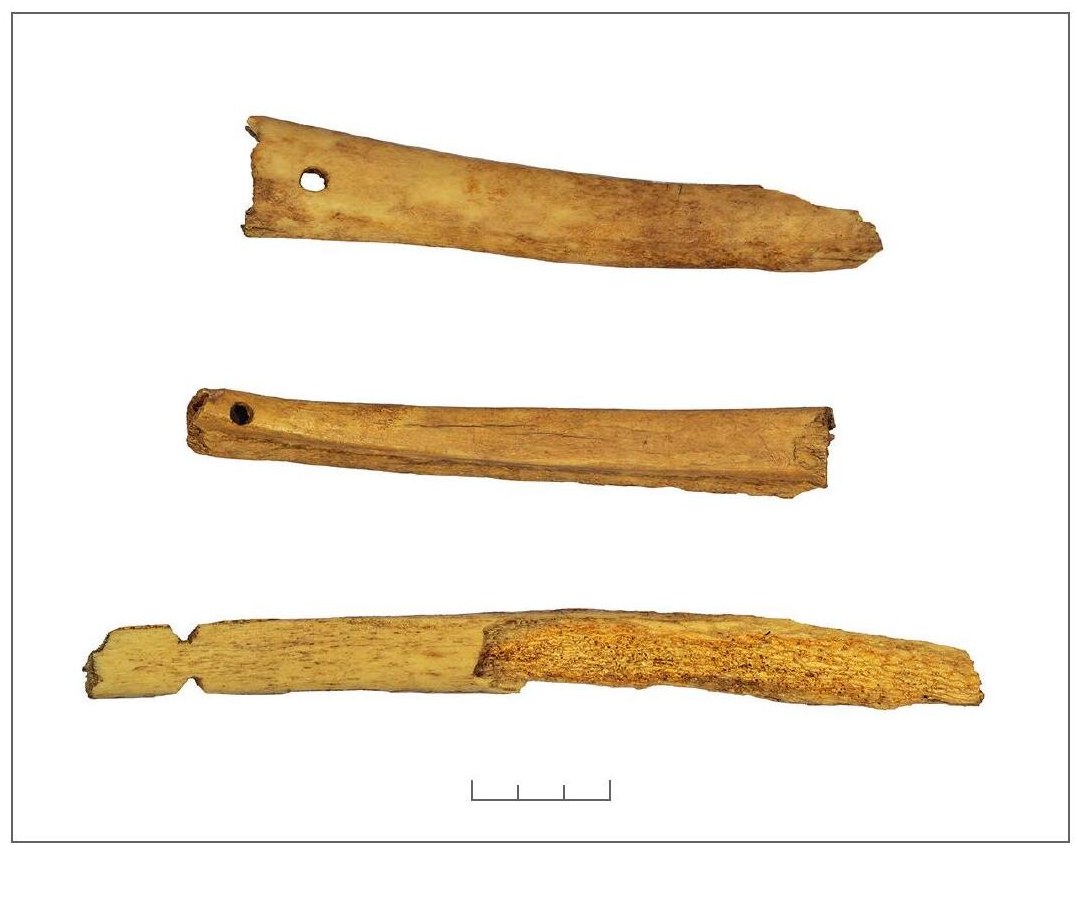
rūcamkauliņš
Source term: rūcamkauliņi (sg. rūcamkauliņš)
rūcamkauliņš = Latvian, 'roaring little bone' (rūkt, to roar or growl + kauliņš, diminutive of kauls, bone); in English, bullroarer; in Dutch, snorrebot.
Cēsis Castle was the Livonian Order's great stronghold in the Latvian uplands, and its moats and slopes have been giving up the debris of five centuries of castle life. Among the animal-bone finds are three blades cut from cattle ribs — one from the defensive moat beside the west bridge wall, one from the western slope, one from the foot of the north tower. Two carry a small round hole at one end; the third has triangular notches sawn into its sides to seat a string. Threaded on a cord and whirled, such a blade turns in the air and gives out a low, roaring, clattering sound. The archaeologist who recognized them, Viesturs Āboltiņš, cut replicas and swung them; the roar settled the question for him. Their nearest kin are not Latvian at all but the rib-bone snorrebot of medieval Belgium and the Low Countries — the same humble noise-maker at the two ends of the Hanseatic world.
Auklā aiz viena gala ievērtu rūcamkauliņu griežot gaisā, tas rada zemu, rūcošu vai plarkšķošu skaņu.
When a rūcamkauliņš threaded on a cord at one end is turned in the air, it produces a low, roaring or clattering sound.
Viesturs Āboltiņš, Cēsu pils raksti V (2024), p. 51
Particulars
- Object
- Three cattle-rib blades: VI 213:1691 (1978, defensive moat beside the west bridge wall), 13.7 cm long, 1.4-1.9 cm wide, with a 4 mm terminal hole; VI 213:7835 (1993, western slope), 13.5 cm, similar; VI 213:8394 (1998, foot of the north tower), with triangular cord notches cut into the sides of one end. Fig. 15 photograph by G. Indrēvica, 2024.
- Function
- Entertainment objects: whirled in the air on a cord threaded through the end hole (or seated in the side notches) for a low, roaring or clattering sound.
Source
Viesturs Āboltiņš, 'Cēsu pilī iegūtie dzīvnieku skeleta materiālu priekšmeti', Cēsu pils raksti V (2024), pp. 51-52 and fig. 15 (photo G. Indrēvica, 2024); Belgian parallels cited to Ervynck 1990 and Van de Walle 1982