No. SERVIER1970-012
Portugal zunas harvest taboo
Portugal · Europe · Iberia
Play / practical
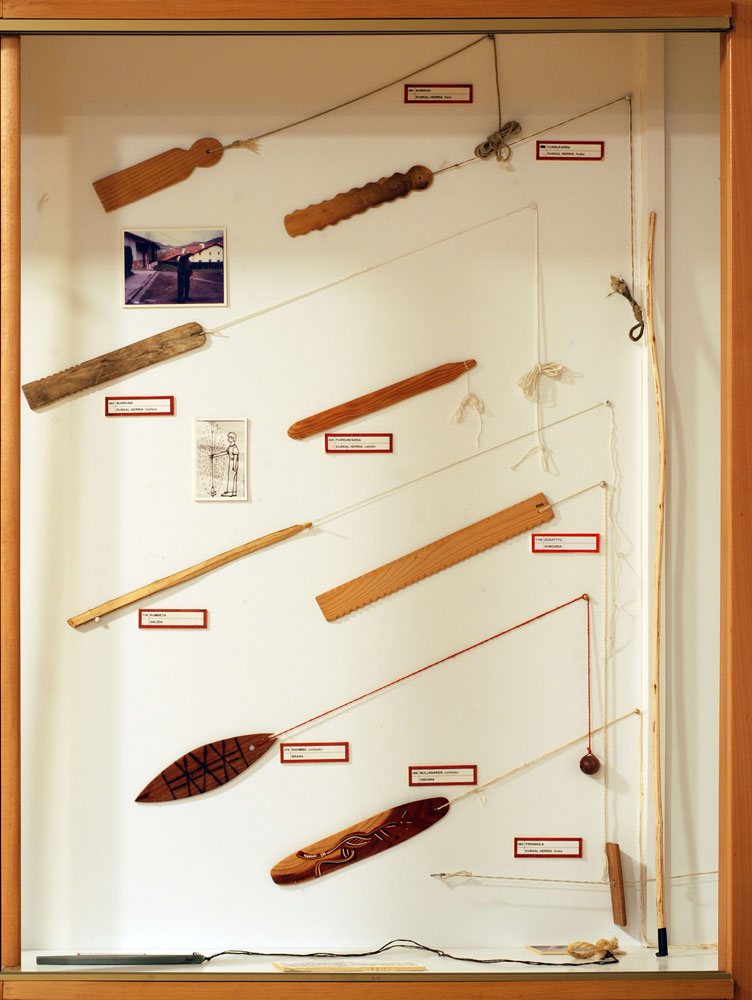
zunas
Source term: zunas / rombos
zuna — Portuguese regional name for a whirling buzzer toy; from zunir, "to drone, hiss." zinideira — Trás-os-Montes: a withe sharpened at one end, fixed by the other to a stick, whirled by boys to make it 'zinir' (Caldas Aulete dictionary).
Etymology. From the sound-imitative root zunir/zinir, "to drone, hiss, buzz" — the same root that names the zinideira of Trás-os-Montes, a strip of withe whirled on a stick to make a sharp hissing sound.
In Portugal, the ethnologist Jean Servier recorded, the old people forbade children to sound their zunas at harvest time, fearing that the buzzing might disturb the souls of the dead, who were thought ready to leave the earth just as the crops were gathered. The zuna itself was a child's toy: in Juncal do Campo, in the Beira Baixa, children cut them from the withe of old baskets, hung them on a length of string, and whirled them until they buzzed — the name comes from zunir, to drone or hiss.
En Portugal, los viejos prohíben a los niños que hagan resonar sus "zunas" o rombos en el momento de las cosechas, quizá por temor de actuar sobre las almas de los muertos prontas a dejar la tierra en el momento de las cosechas.
In Portugal, the old people forbid children to sound their "zunas" or bullroarers at harvest time, perhaps for fear of acting upon the souls of the dead, ready to leave the earth at the moment of the harvest.
Jean Servier, El hombre y lo invisible (Spanish trans. of L'homme et l'invisible), p. 140
Particulars
- Object
- A piece of withe cut from an old basket and hung on a string.
- Function
- A child's buzzer, forbidden by the elders while the crops came in.
Source
Jean Servier, El hombre y lo invisible (Spanish trans. of L'homme et l'invisible, 1964), p. 140; Joaquim P. de Matos, 'Juncal do Campo: crianças, jogos e brinquedos,' Reconquista, 15 June 2023