No. SEA-004
Tinguian Patoc pabilbil bullroarer
Philippines · Abra · Patoc · Luzon · Southeast Asia
Play / practical
pabilbil
Source term: bull roarer
pabilbil (Tinguian/Itneg) — the whirled bullroarer, not to be confused with bilbil/bungkaka, the struck bamboo buzzer of Cordillera women.
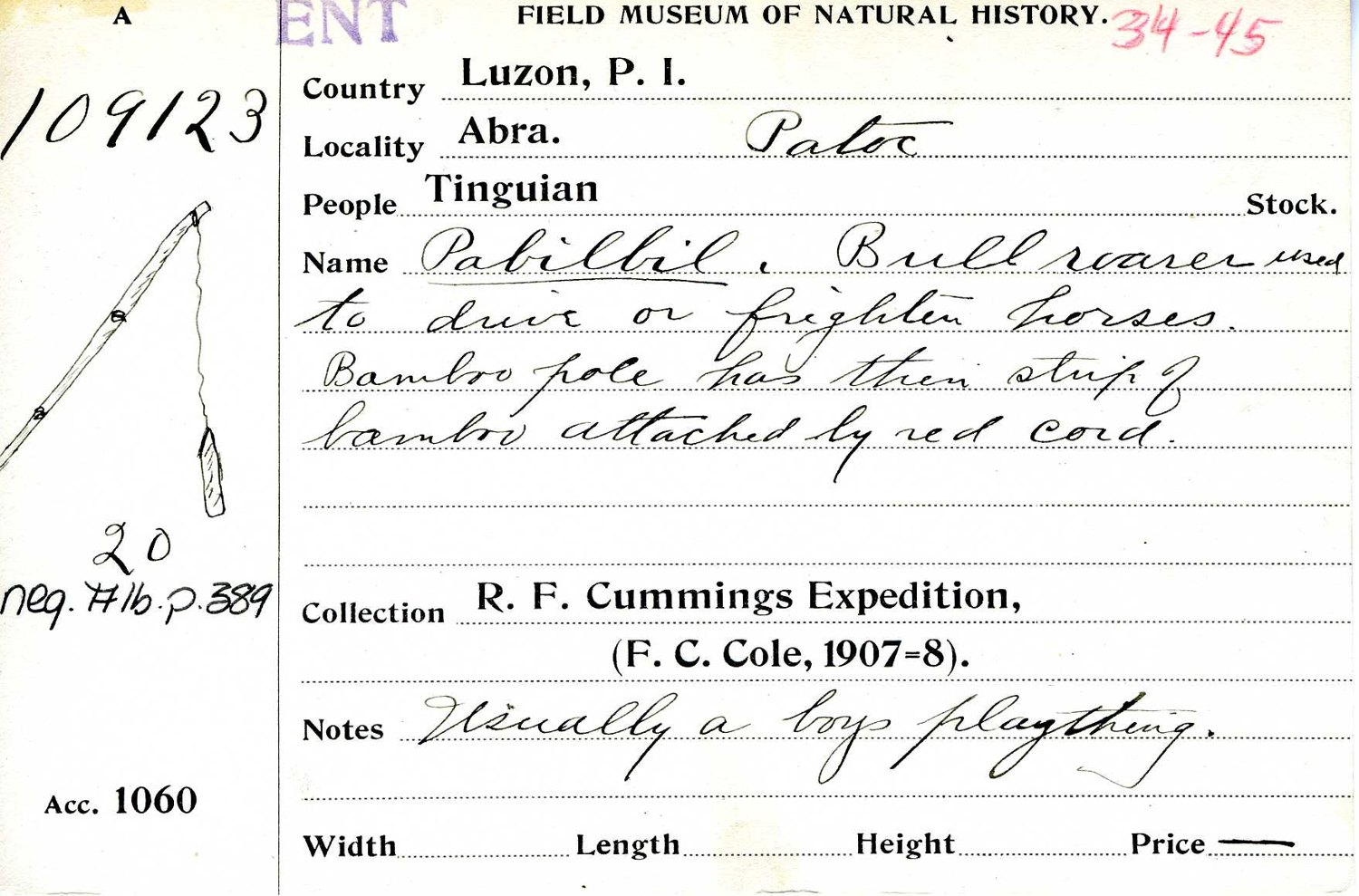
At Patoc, boys swung the pabilbil overhead for the pleasure of its roar—and to send stray horses running. Fay-Cooper Cole collected this complete bamboo rig in 1907–08: a thin blade suspended by red cord from a long handle.
pabilbil, bull roarer, used to drive or frighten horses; bamboo pole has thin strip of bamboo attached by red cord; usually a boy's plaything
E. Arsenio Manuel, 'Toward an Inventory of Philippine Musical Instruments,' Asian Studies 14, no. 1 (1976): 10 (Field Museum of Natural History Tinguian inventory, Sp. No. 109123).
Particulars
- Object
- Thin bamboo blade tied by a red cord to a long bamboo handle; Field Museum 109123. A Philippine rig of the same build is in the Penn Museum, Philadelphia: object 22287, a flat bamboo blade only 15.7 centimetres long, pointed at one end and notched at the other for its string, with a separate tapered bamboo handle.
- Function
- A boys’ plaything swung overhead to make a pleasing roar and drive stray horses.
Source
E. Arsenio Manuel, 'Toward an Inventory of Philippine Musical Instruments,' Asian Studies 14, no. 1 (1976): 10 (Field Museum of Natural History, Sp. No. 109123, collected by F. C. Cole, 1907-1908); Fay-Cooper Cole, The Tinguian: Social, Religious, and Economic Life of a Philippine Tribe (Field Museum Anthropological Series XIV, no. 2, 1922), p. 274